The Painted Stoa › The strange
The Antikythera mechanism
A bronze calculator of the heavens, from a shipwreck of about 60 BC
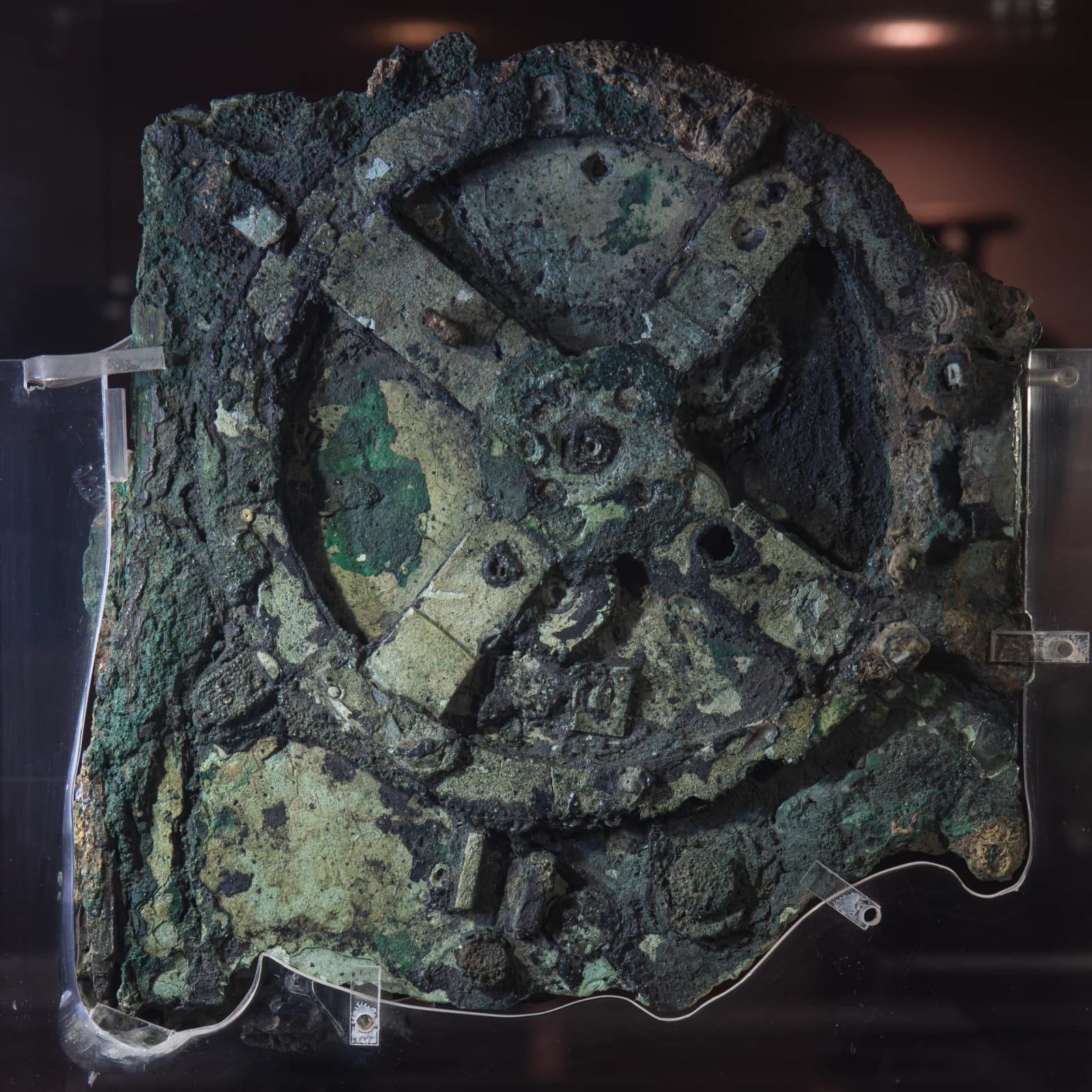
In 1901, divers working a shipwreck off the small island of Antikythera brought up bronze and marble statues, glass and pottery, and a shapeless lump of corroded bronze and wood. A year later someone noticed a gearwheel inside it. More than a century of study, lately with X-ray scanning, has shown that it was a hand-cranked machine that modelled the movements of the sun and moon, predicted eclipses and counted the years to the next Olympic Games. Nothing remotely like it survives from the ancient world.
A wreck full of treasure
The wreck was found in 1900 by sponge divers sheltering from a storm, and salvaged in 1900–1901 in one of the first large underwater recoveries. The ship, which went down around 70–60 BC, was carrying luxury goods, probably towards Italy. Among the finds was a wooden box about the size of a large book, which broke into fragments as it dried. On 17 May 1902 the archaeologist Valerios Stais saw a gearwheel in one of them.
Well established Today there are 82 fragments, holding about thirty bronze gearwheels. Perhaps a third of the original machine survives.
What it did
Turning a handle on the side moved everything at once. On the front, pointers showed the position of the sun and moon in the zodiac and the date in a 365-day calendar; a small half-silvered ball turned to show the phase of the moon. On the back were two great spiral dials.
- The upper spiral counted a cycle of 235 lunar months, which equal nineteen solar years almost exactly, so that a calendar of months could be kept in step with the seasons.
- The lower spiral covered 223 lunar months, the cycle after which eclipses repeat, and marked the months in which eclipses of the sun and moon could be expected.
- Smaller dials counted the four-year cycle of the great games: Olympia, Nemea, the Isthmus and Delphi.
Well established The gearing even reproduced the moon's changing speed across the sky, using two gears on slightly different axes linked by a pin in a slot: a mechanical model of an astronomical theory.
The astronomy behind it
The cycles were not invented for the machine. Greek astronomers had worked them out and wrote them down. The astronomer Geminus, probably of the first century BC, explains the nineteen-year cycle, and credits it to Euctemon, Philip and Callippus.
ἑτέραν περίοδον συνεστήσαντο τὴν τῆς ἐννεακαιδεκαετηρίδος οἱ περὶ Εὐκτήμονα καὶ Φίλιππον καὶ Κάλλιππον ἀστρολόγοι.“the astronomers Euctemon, Philip and Callippus established another period, the nineteen-year cycle.”
He also defines the exeligmos, three eclipse cycles long, which appears on the mechanism's eclipse dial too.
Ἐξελιγμός ἐστι χρόνος ἐλάχιστος περιέχων ὅλους μῆνας καὶ ὅλας ἡμέρας καὶ ὅλας ἀποκαταστάσεις τῆς σελήνης.“The exeligmos is the shortest period that contains a whole number of months, a whole number of days and a whole number of returns of the moon.”
Who made it, and when?
Debated among scholars The month names on the calendar dial are those of Corinth or one of its colonies, which has led some researchers to suggest Syracuse, the Corinthian colony where Archimedes had built a famous model of the heavens in the third century BC, and others the Corinthian colonies of north-western Greece. The date of manufacture is also argued: the inscriptions look like second-century BC lettering, and some calculations based on the eclipse dial point to a starting date in the late third century BC.
Debated among scholars The front of the machine is badly damaged, and whether it also showed the five planets known in antiquity is reconstructed rather than seen. The inscriptions name planets, and the most detailed modern reconstruction, published in 2021, includes them.
Why it matters
Before the mechanism, historians assumed that geared machines of this complexity were a late medieval invention. The mechanism shows that the Hellenistic world had the mathematical astronomy and the craftsmanship to build a working model of the heavens. It is also a warning: it survived by the accident of a shipwreck, and there may have been others like it that were melted down for their bronze.
- c. 205–100 BCThe mechanism is made; the exact date is disputed. Debated among scholars
- c. 70–60 BCThe ship carrying it sinks off Antikythera.
- 1900–1901Sponge divers find the wreck; the cargo is salvaged.
- 17 May 1902Valerios Stais notices a gearwheel in one fragment.
- 1974Derek de Solla Price publishes Gears from the Greeks, from X-ray images.
- 2005–2006New X-ray scans and surface imaging reveal far more gears and text.
- 2021A reconstruction of the front, with the planets, matching all the evidence then known. Debated among scholars
Read it yourself
Sources
Ancient sources, in the library
Modern scholarship
- Alexander Jones, A Portable Cosmos: Revealing the Antikythera Mechanism, Scientific Wonder of the Ancient World (New York: Oxford University Press, 2017). The whole story, from the wreck to the latest research.
- Derek de Solla Price, Gears from the Greeks: The Antikythera Mechanism, a Calendar Computer from ca. 80 B.C. (Transactions of the American Philosophical Society 64.7, 1974). The first detailed study.
- T. Freeth and others, Decoding the ancient Greek astronomical calculator known as the Antikythera Mechanism (Nature 444, 587–591, 2006). The scans that transformed the subject.
- T. Freeth, A. Jones, J. Steele and Y. Bitsakis, Calendars with Olympiad display and eclipse prediction on the Antikythera Mechanism (Nature 454, 614–617, 2008). The Corinthian calendar and the games dial.
- T. Freeth and others, A Model of the Cosmos in the ancient Greek Antikythera Mechanism (Scientific Reports 11, 5821, 2021). A reconstruction of the whole front.
Every Greek quotation here is checked word for word against the edition it cites, and every translation against the translation named. Written 27 September 2026.