The Painted Stoa › Religion and belief
Delphi and the oracleΔελφοί
Where kings asked Apollo, and the answers could ruin them
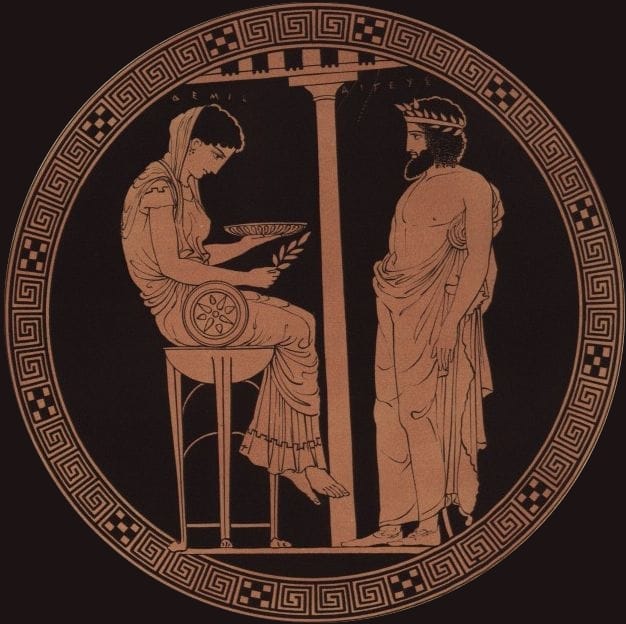
On a ledge of Mount Parnassus, for a thousand years and more, a woman sat on a tripod in the innermost room of Apollo's temple and spoke for the god. Cities asked her where to found colonies, kings asked whether to go to war, and ordinary people asked about marriages and debts. What happened in that room is still argued over: divine inspiration, theatre, trance, or, as geologists proposed in 2001, gas rising through a crack in the rock.
The priestess on the tripod
The god's voice at Delphi was the Pythia, a woman of the town who served as Apollo's priestess. The geographer Strabo, writing around the time of Augustus, reports what people said of the seat of the oracle.
φασὶ δʼ εἶναι τὸ μαντεῖον ἄντρον κοῖλον κατὰ βάθους οὐ μάλα εὐρύστομον, ἀναφέρεσθαι δʼ ἐξ αὐτοῦ πνεῦμα ἐνθουσιαστικόν, ὑπερκεῖσθαι δὲ τοῦ στομίου τρίποδα ὑψηλόν, ἐφʼ ὃν τὴν Πυθίαν ἀναβαίνουσαν δεχομένην τὸ πνεῦμα ἀποθεσπίζειν ἔμμετρά τε καὶ ἄμετρα“They say that the seat of the oracle is a cave that is hollowed out deep down in the earth, with a rather narrow mouth, from which arises breath that inspires a divine frenzy; and that over the mouth is placed a high tripod, mounting which the Pythian priestess receives the breath and then utters oracles in both verse and prose”
Plutarch, who was himself a priest at Delphi around AD 100, adds a detail that has fascinated modern scientists. From time to time, not regularly, the room where visitors waited was filled with a sweet smell.
ὁ γὰρ οἶκος, ἐν ᾧ τοὺς χρωμένους τῷ θεῷ καθίζουσιν, οὔτε πολλάκις οὔτε τεταγμένως ἀλλʼ ὡς ἔτυχε διὰ χρόνων εὐωδίας ἀναπίμπλαται καὶ πνεύματος“the room in which they seat those who would consult the god is filled, not frequently or with any regularity, but as it may chance from time to time, with a delightful fragrance coming on a current of air”
Answers that could be read two ways
The oracle's most famous answers are the ambiguous ones. Herodotus tells how Croesus, king of Lydia, asked whether he should make war on Persia and was told that he would destroy a great empire. He attacked, and the empire he destroyed was his own. When Croesus complained, the god answered that he should have asked which empire was meant.
Debated among scholars The American scholar Joseph Fontenrose sorted every recorded response into those reported by contemporaries and those known only from later stories. The riddling, doom-laden answers belong almost entirely to the second group. The responses that inscriptions and contemporary writers record are mostly plain answers to practical questions: which god to sacrifice to, whether a proposed course of action was acceptable.
A trance, and a death
Ancient tradition / legend Plutarch describes a session that went wrong. A foreign delegation had come; the omens were bad, but the priests forced them. The Pythia went down into the shrine unwillingly, answered in a harsh voice, then, he says, with a terrible cry rushed for the exit and threw herself down. Everyone fled. She was carried out still conscious, and lived for only a few days.
Was there a vapour?
Ancient writers speak of a pneuma, a breath or vapour, rising from a chasm under the tripod. When French archaeologists excavated the temple around 1900 they found no chasm, and for most of the twentieth century scholars treated the vapour as a myth.
Debated among scholars In 2001 a team led by the geologist Jelle de Boer and the archaeologist John Hale reported that two geological faults cross beneath the temple and that the local spring water contains traces of light hydrocarbon gases, among them ethylene, which has a sweet smell. They suggested that the Pythia's trance was a mild intoxication. Other researchers have replied that the amounts of gas measured would have been far too small to produce any trance, and that the ancient descriptions do not fit ethylene. The question is open.
Why cities kept asking
However it worked, Delphi mattered because the Greeks believed it. It sanctioned the founding of colonies, arbitrated between cities, received the treasuries and statues that rival states set up along the Sacred Way, and hosted the Pythian Games. Its authority survived the Persian Wars, in which it had advised caution, and lasted until the late fourth century AD, when Christian emperors closed the pagan sanctuaries.
- 8th c. BCThe oracle of Apollo at Delphi becomes known across the Greek world.
- c. 547 BCCroesus attacks Persia after consulting Delphi, and loses his kingdom. Ancient tradition / legend
- c. AD 100Plutarch, a priest at Delphi, writes on the oracle's decline.
- Late 4th c. ADThe pagan sanctuaries are closed under Christian emperors.
- 1892–1903The French 'Great Excavation' uncovers the sanctuary; no chasm is found.
- 2001De Boer and Hale propose that gases rising along faults caused the trance. Debated among scholars
Read it yourself
- Herodotus 1.46–56Croesus tests the oracles, then asks about Persia.Open in the Scroll →
- Herodotus 1.91Apollo's answer to Croesus' complaint.Open in the Scroll →
- Strabo 9.3.5The chasm, the vapour and the tripod.Open in the Scroll →
- Plutarch, On the Obsolescence of Oracles 50–51The fragrance, and the priestess who died.Open in the Scroll →
Sources
Ancient sources, in the library
Modern scholarship
- Michael Scott, Delphi: A History of the Center of the Ancient World (Princeton: Princeton University Press, 2014). The whole history of the sanctuary.
- Joseph Fontenrose, The Delphic Oracle: Its Responses and Operations, with a Catalogue of Responses (Berkeley: University of California Press, 1978). Every recorded response, sorted by how well it is attested.
- J. Z. de Boer, J. R. Hale and J. Chanton, New evidence for the geological origins of the ancient Delphic oracle (Greece) (Geology 29, 707–710, 2001). The gas hypothesis.
- J. Foster and D. Lehoux, The Delphic oracle and the ethylene-intoxication hypothesis (Clinical Toxicology 45, 85–89, 2007). The case against it.
Every Greek quotation here is checked word for word against the edition it cites, and every translation against the translation named. Written 27 September 2026.