Linear B
The oldest written Greek, read at last in 1952
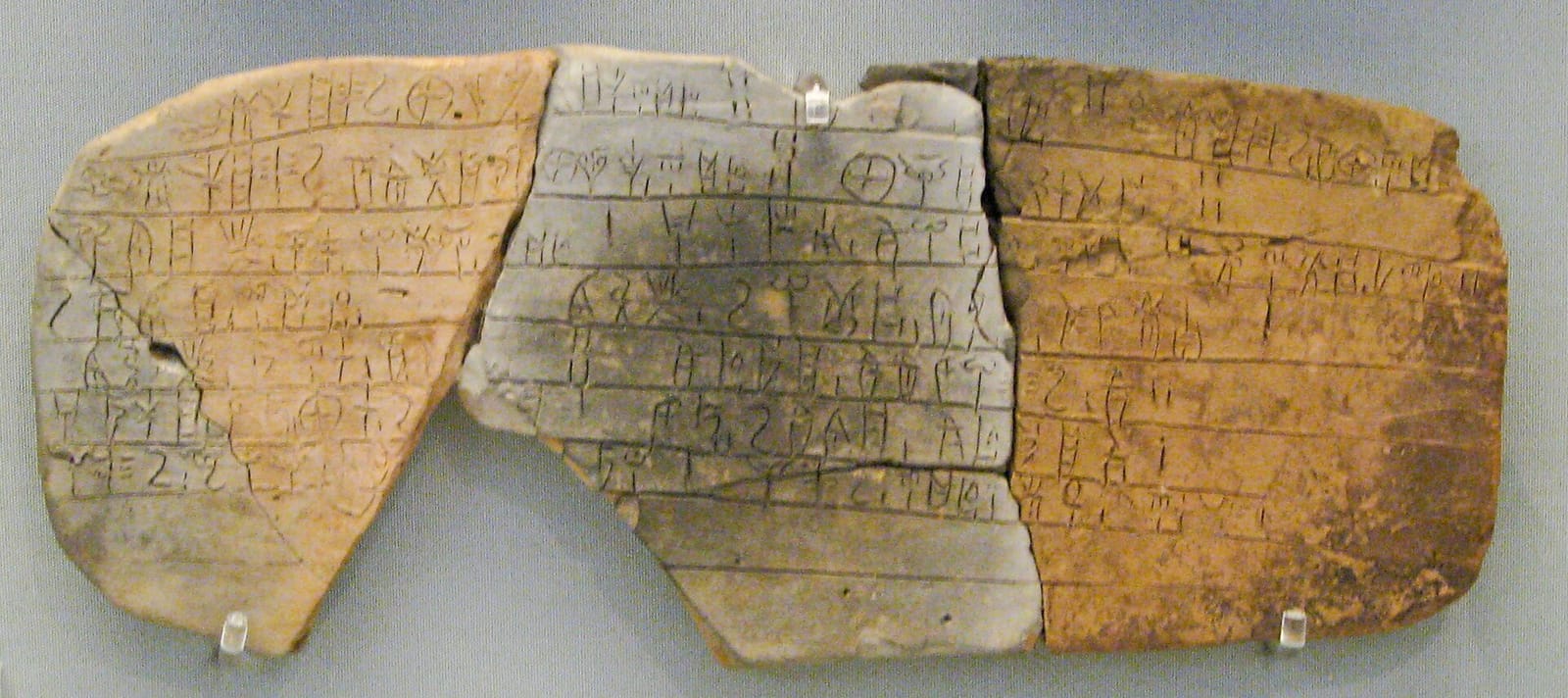
For half a century after they were dug up, thousands of clay tablets from the Bronze Age palaces of Crete and mainland Greece kept their secret. Their script, which the archaeologist Arthur Evans called "Linear B", matched no known language. In 1952 an English architect, Michael Ventris, showed that it was Greek: Greek written some five hundred years before Homer, in the accounts of palace clerks counting sheep, bronze, perfume and slaves.
Tablets that were never meant to last
The tablets are lists and receipts, written on unbaked clay and kept only as long as they were needed. They survive because the palaces that kept them burned, and the fires baked the clay hard. Arthur Evans found the first large archive at Knossos in Crete, which he began excavating in 1900. In 1939 the American Carl Blegen found a second archive at Pylos in the south-western Peloponnese, the kingdom that Homer gives to old Nestor.
οἳ δὲ Πύλον τʼ ἐνέμοντο καὶ Ἀρήνην ἐρατεινὴν“and they that dwelt in Pylos and lovely Arene”
Debated among scholars The Pylos tablets date from the destruction of the palace, around 1200 BC. The date of the Knossos archive has been argued over since Evans' day; most scholars now place it in the fourteenth century BC, some later.
A script of syllables
Linear B is not an alphabet. It has about ninety signs, most standing for a syllable (da, me, po), plus pictures for the things being counted: men, women, horses, chariot wheels, tripods, jars. The syllables fit Greek badly: final consonants are left out, and l and r are written with the same signs. So Greek tripos, "tripod", appears as ti-ri-po, and the god Poseidon as po-se-da-o.
How it was cracked
The decisive preparation was done by Alice Kober, a classicist at Brooklyn College, who showed from the tablets alone that the language had endings that changed with grammar, and grouped the signs that shared a consonant or a vowel. She died in 1950, before the solution.
Well established Michael Ventris, working on a grid built on Kober's method, tested the guess that some words were place names in Crete. The words came out as Knossos, Amnisos and Tulisos, and then as recognisable Greek. He announced the result in 1952, and with the Cambridge philologist John Chadwick published the proof in 1953.
What the tablets say
The tablets show a world of palace bureaucracy that Homer's poems barely remember: rations for named workers, flocks counted to the animal, bronze issued to smiths, and offerings to gods whose names were already Greek. Zeus, Hera, Poseidon and even Dionysus appear, centuries before any Greek literature.
Debated among scholars Whether Homer knew anything of writing is itself argued. His only mention of it is the story of Bellerophon, sent to Lycia carrying a folded tablet of "baneful signs" that asked for his own death. Some read the sēmata as writing, others as a secret code of marks.
πόρεν δʼ ὅ γε σήματα λυγρὰ
γράψας ἐν πίνακι πτυκτῷ θυμοφθόρα πολλά,“gave him baneful tokens, graving in a folded tablet many signs and deadly,”
After the palaces
When the palaces fell, around 1200 BC, Linear B disappeared with them. On the Greek mainland and in the Aegean no writing survives for about four centuries, until the Greeks adapted the Phoenician alphabet in the eighth century BC, the ancestor of the letters in this sentence. Only on Cyprus did Greeks go on writing their language, in a related syllabic script.
- c. 1400 BCThe Knossos archive (its date is disputed). Debated among scholars
- c. 1200 BCFire destroys the palace of Pylos, baking its tablets.
- 1900Arthur Evans begins excavating Knossos and finds tablets.
- 1939Carl Blegen finds the Pylos archive.
- 1950Alice Kober dies, her method in place.
- 1952Michael Ventris announces that Linear B is Greek.
- 1953Ventris and Chadwick publish the proof; the Pylos tripod tablet confirms it.
Read it yourself
Sources
Ancient sources, in the library
Modern scholarship
- Michael Ventris and John Chadwick, Evidence for Greek Dialect in the Mycenaean Archives (Journal of Hellenic Studies 73, 84–103, 1953). The decipherment, published.
- John Chadwick, The Decipherment of Linear B (Cambridge: Cambridge University Press, 1958). The story, told by Ventris' collaborator, for general readers.
- Margalit Fox, The Riddle of the Labyrinth: The Quest to Crack an Ancient Code (New York: Ecco, 2013). The decipherment, and Alice Kober's part in it.
Every Greek quotation here is checked word for word against the edition it cites, and every translation against the translation named. Written 27 September 2026.