The Painted Stoa › People and power
PericlesΠερικλῆς
The aristocrat who led the Athenian democracy for a generation
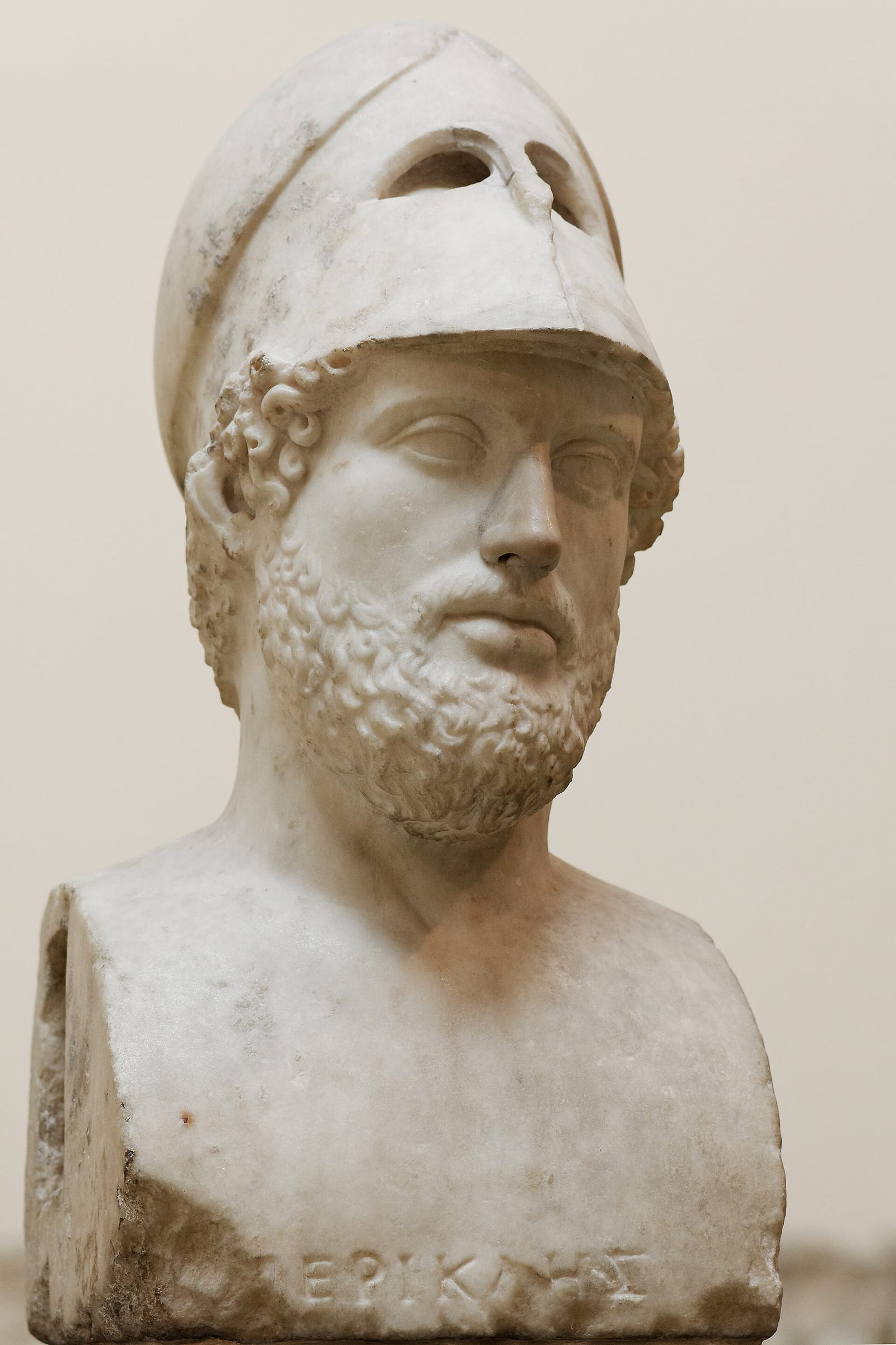
For about thirty years in the middle of the fifth century BC, the most powerful man in Athens held only an office the Assembly filled by vote every year: general. Pericles was re-elected again and again, persuaded the Assembly to build the Parthenon, and led the city into the war with Sparta that would end its empire. His admirers called him "the Olympian"; the comic poets called him "squill-head". Thucydides, who lived through those years, thought he was the only thing holding Athens together.
A family at the top
Pericles was born into the Athenian upper class on both sides, as Plutarch puts it. His father Xanthippus commanded the Greeks who beat the Persians at Mycale in 479 BC; his mother Agariste belonged to the Alcmaeonids, the family of Cleisthenes, who had founded the democracy in 508/7 BC.
Debated among scholars His birth year is not recorded. It is usually put about 495 BC, because he was already prominent in the 460s.
A leader of the people
He made his name in the 460s on the popular side. The Constitution of the Athenians, written in Aristotle's school, credits him with taking powers from the Areopagus, the old council of former magistrates (Plutarch says the reform was carried through by Ephialtes, with Pericles behind it), and with being the first to pay citizens for sitting on juries, so that poor men could afford to serve. The same work says he did it to outbid his rich rival Cimon, who fed his fellow villagers from his own estate.
In 451/0 BC, on his proposal, the Assembly decided that only a man born of two Athenian parents could be a citizen. The law would come back to trouble him: his long companion Aspasia came from Miletus, so their son could not be a citizen. Near the end of Pericles' life, after his two legitimate sons had died, the Assembly let him enrol the boy as an exception. That son, Pericles the younger, was one of the generals executed after the battle of Arginusae in 406 BC.
The Olympian
ἐντεῦθεν ὀργῇ Περικλέης οὑλύμπιος
ἤστραπτʼ ἐβρόντα ξυνεκύκα τὴν Ἑλλάδα,“Then in his anger Pericles the Olympian lightened and thundered and stirred all Greece into confusion,”
Aristophanes' joke points at his speaking. Plutarch lists the explanations for the nickname: his lofty style, which he was said to have learned from the philosopher Anaxagoras, or the buildings with which he adorned the city, or simply his power. He also records the less flattering names. Pericles' head was unusually long, so the comic poets called him *schinokephalos*, "squill-head", after the sea squill, a plant with a big bulb. Plutarch explains that this is why almost all his portraits show him in a helmet: the sculptors did not want to mock him.
After his last serious rival, Thucydides son of Melesias (not the historian), was ostracised about 443 BC, Pericles was elected general every year for fifteen years in a row.
The building programme
In 454 BC the treasury of the Delian League, the alliance of Greek cities against Persia, was moved from the island of Delos to Athens. Over the next decades the Athenians rebuilt the Acropolis, which the Persians had burned in 480 BC: the Parthenon, begun in 447 BC, the gateway called the Propylaia, and more. Pericles' opponents protested that the allies' money was paying for it.
ὁρῶσα τοῖς εἰσφερομένοις ὑπʼ αὐτῆς ἀναγκαίως πρὸς τὸν πόλεμον ἡμᾶς τὴν πόλιν καταχρυσοῦντας καὶ καλλωπίζοντας ὥσπερ ἀλαζόνα γυναῖκα, περιαπτομένην λίθους πολυτελεῖς καὶ ἀγάλματα καὶ ναοὺς χιλιοταλάντους.“when she sees that, with her own enforced contributions for the war, we are gilding and bedizening our city, which, for all the world like a wanton woman, adds to her wardrobe precious stones and costly statues and temples worth their millions.”
Well established The buildings and their dates are known from the building accounts the Athenians inscribed on stone, many of which survive. How far Pericles personally directed the work is less clear: Plutarch's account was written more than five hundred years later.
The Funeral Oration
In the winter of 431/0 BC, after the first year of war with Sparta, Pericles was chosen to speak at the public funeral for the dead. The speech Thucydides gives him is the most famous description of Athenian democracy ever written.
καὶ ὄνομα μὲν διὰ τὸ μὴ ἐς ὀλίγους ἀλλ’ ἐς πλείονας οἰκεῖν δημοκρατία κέκληται·“It is true that our government is called a democracy, because its administration is in the hands, not of the few, but of the many;”
Debated among scholars Thucydides says plainly that he could not recall speeches word for word, and wrote what each speaker would most likely have said, keeping as close as he could to the general sense. The Funeral Oration is Pericles' thought in Thucydides' words, and how much of each is in it is argued.
Plague, and a verdict
Pericles' strategy was to bring the people of Attica inside the city walls, let the Spartans ravage the countryside, and fight at sea. In 430 BC plague broke out in the crowded city. The Athenians turned on him and fined him, then soon elected him general again. He caught the plague himself and died in 429 BC. Plutarch tells how, as he lay dying, his friends listed his victories, thinking he could no longer hear them.
οὐδεὶς γάρ, ἔφη, διʼ ἐμὲ τῶν ὄντων Ἀθηναίων μέλαν ἱμάτιον περιεβάλετο.“for, said he, no living Athenian ever put on mourning because of me.”
Thucydides' judgement, written after Athens had lost the war, is that Pericles was the one leader strong enough to tell the Assembly what it did not want to hear, and that his successors, competing for the people's favour, threw away what he had built.
ἐγίγνετό τε λόγῳ μὲν δημοκρατία, ἔργῳ δὲ ὑπὸ τοῦ πρώτου ἀνδρὸς ἀρχή.“And so Athens, though in name a democracy, gradually became in fact a government ruled by its foremost citizen.”
Debated among scholars Modern historians are divided on Pericles. Some follow Thucydides; others point out that the historian was an admirer writing with hindsight, that the war strategy he praises was a gamble, and that the empire Pericles strengthened was the thing its subjects most resented. Plato, a generation later, has Socrates repeat the charge that Pericles, by bringing in public pay, made the Athenians idle, cowardly, talkative and greedy.
- c. 495 BCPericles is born, son of Xanthippus and Agariste. Debated among scholars
- 479 BCHis father Xanthippus commands at the victory of Mycale.
- 462/1 BCEphialtes strips the Areopagus of most of its powers, with Pericles' support.
- 454 BCThe Delian League treasury is moved to Athens.
- 451/0 BCHis law: citizens must have an Athenian mother and father.
- 447 BCWork begins on the Parthenon.
- c. 443 BCHis rival Thucydides son of Melesias is ostracised.
- 431 BCWar with Sparta; the Funeral Oration that winter.
- 430 BCPlague in Athens; Pericles is fined, then re-elected.
- 429 BCPericles dies of the plague.
Read it yourself
Sources
Ancient sources, in the library
Modern scholarship
- Vincent Azoulay, translated by Janet Lloyd, Pericles of Athens (Princeton: Princeton University Press, 2014). A modern biography, and how Pericles was remembered.
- Philip A. Stadter, A Commentary on Plutarch's Pericles (Chapel Hill: University of North Carolina Press, 1989). A line-by-line commentary on Plutarch's life.
- P. J. Rhodes, A Commentary on the Aristotelian Athenaion Politeia (Oxford: Clarendon Press, 1981). On the Constitution of the Athenians.
Every Greek quotation here is checked word for word against the edition it cites, and every translation against the translation named. Written 27 September 2026.