The Painted Stoa › Archaeology
Black-figure and red-figure
How Athenian potters made pictures that have lasted 2,500 years
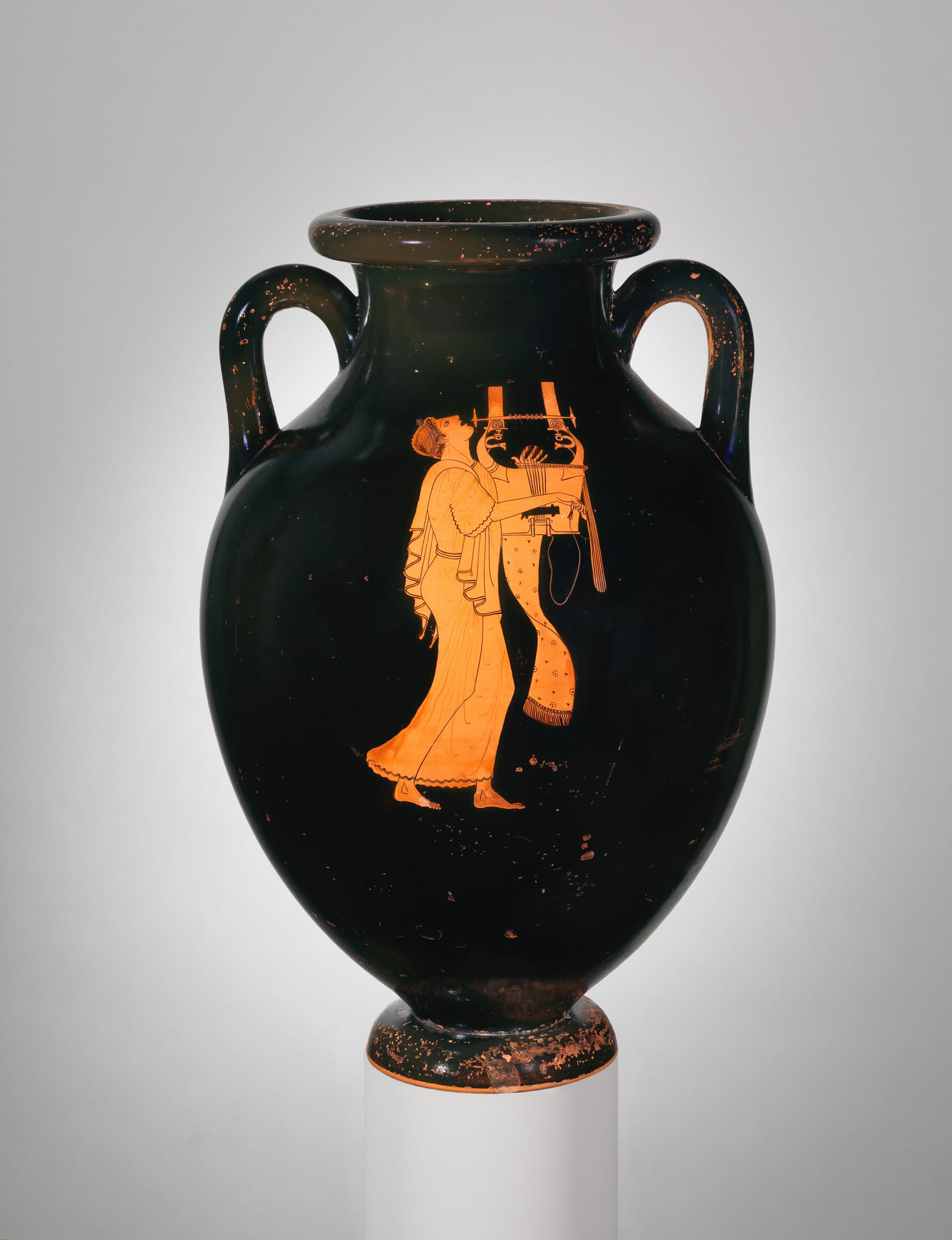
The painted pots of Athens are the largest body of Greek pictures to survive: gods and heroes, athletes and drinkers, weddings, funerals and battles, on thousands of vessels that were made to be used. They were made in two main styles, black figures on the red clay and, from about 530 BC, red figures on a black ground. Both depended on the same trick of the kiln, and both tell archaeologists how old a layer of earth is.
The same clay, two colours
Athenian clay fires to a warm orange-red. The black is not a paint in the usual sense but a very fine slip of the same clay. In a kiln fired in three stages, first with plenty of air, then starved of air, then with air again, the whole pot turns black in the middle stage, and in the last stage the coarser clay turns red again while the dense slip stays black.
Well established This three-stage firing is how Athenian black was made. It was worked out by modern experiment in the twentieth century; no ancient writer describes it.
Black-figure
In black-figure, the painter drew the figures in slip as dark silhouettes, then scratched details through them with a sharp point, so that the red clay showed in fine lines: muscles, folds of cloth, the feathers of a helmet crest. Touches of added red and white marked blood, beards and women's skin. The technique came from Corinth, and Athenian workshops took it up in the late seventh century BC.
The greatest black-figure painter, most would say, was Exekias, who signed pots both as potter and as painter in the third quarter of the sixth century BC. His amphora in the Vatican shows Achilles and Ajax bent over a board game during a lull in the fighting at Troy, a scene in no surviving text.
Red-figure
Around 530 BC an Athenian workshop reversed the method. The painter now left the figures in the red of the clay and painted the background black. Details were drawn with a brush instead of scratched, so lines could swell and taper, and painters began to show bodies turning in space, foreshortened feet, and faces in three-quarter view. Within a generation red-figure had replaced black-figure for most fine pottery.
Debated among scholars Who invented red-figure is argued; the earliest pieces come from the circle of the potter Andokides, and some vases of this time are painted in black-figure on one side and red-figure on the other.
The oil that came in painted jars
One kind of pot stayed black-figure for centuries after red-figure had taken over: the prize amphorae of the Panathenaic Games in Athens, filled with oil from Athena's sacred olive trees, with Athena on one side and the contest on the other. The conservatism was deliberate: the old style marked them as prizes. Pindar describes the prize that came home to Argos.
γαίᾳ δὲ καυθείσᾳ πυρὶ καρπὸς ἐλαίας
ἔμολεν Ἥρας τὸν εὐάνορα λαὸν ἐν ἀγγέων ἕρκεσιν παμποικίλοις.“and in earth baked by fire olive oil came to the fine men of Hera’s city in jars with richly painted sides.”
Who painted them?
Most painters never signed their work. In the early twentieth century the Oxford scholar John Beazley began attributing unsigned vases to individual painters by the way they drew small details: ankles, ears, the folds at an elbow. He gave the anonymous artists names, many after a museum or a subject. One of his earliest studies, in 1911, gathered the work of the "Master of the Berlin Amphora", now called the Berlin Painter.
Debated among scholars Beazley eventually attributed tens of thousands of vases. His method is still the basis of the subject, but scholars debate how far it recovers real individuals, and how far it fits workshops where several hands worked on one pot.
Why archaeologists love them
Because painting styles changed quickly and are well studied, a single sherd of fine painted pottery can often date the layer it was found in to within a generation. That makes Athenian pottery one of the most important dating tools in Mediterranean archaeology, far beyond Athens: it was exported everywhere, above all to Etruscan Italy, where most of the finest vases were found in tombs.
- 7th c. BCBlack-figure develops at Corinth.
- Late 7th c. BCAthenian workshops take up black-figure.
- c. 550–525 BCExekias at work.
- c. 530 BCRed-figure is invented in Athens.
- c. 500–460 BCThe Berlin Painter at work.
- 1911Beazley publishes his study of the Berlin Painter, one of his first attributions.
Read it yourself
Sources
Ancient sources, in the library
Modern scholarship
- John Boardman, Athenian Black Figure Vases: A Handbook (London: Thames and Hudson, 1974). The standard handbook to black-figure.
- John Boardman, Athenian Red Figure Vases: The Archaic Period: A Handbook (London: Thames and Hudson, 1975). Its sequel for early red-figure.
- Joseph Veach Noble, The Techniques of Painted Attic Pottery (revised edition) (London: Thames and Hudson, 1988). How the pots were shaped, painted and fired.
- J. D. Beazley, The Master of the Berlin Amphora (Journal of Hellenic Studies 31, 276–295, 1911). Beazley's study of the Berlin Painter.
Every Greek quotation here is checked word for word against the edition it cites, and every translation against the translation named. Written 27 September 2026.