Diogenes the CynicΔιογένης ὁ κύων
The philosopher who lived in a jar and told Alexander to move
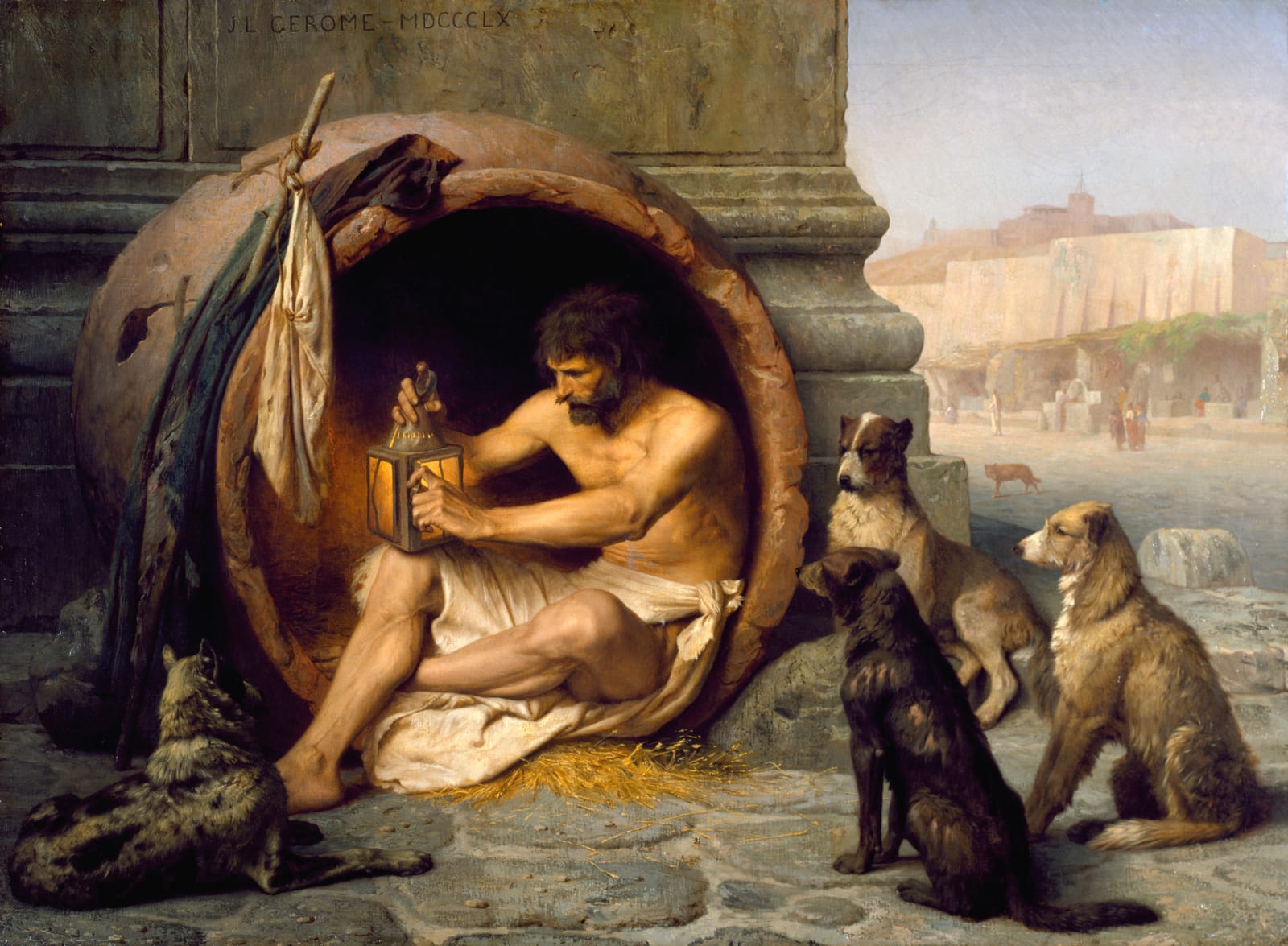
Diogenes of Sinope owned a cloak, a staff, a bag and, for a while, a cup, until he saw a child drinking from its hands and threw the cup away. He slept in a large storage jar in the middle of Athens, ate and did everything else in public, and answered kings and philosophers with insults. People called him "the Dog", kyōn, and "Cynic", doglike, became the name for those who followed his way of life. Almost everything we know about him comes as anecdotes, and the good ones are too good to be entirely true.
A man with a past
Diogenes came from Sinope, a Greek city on the Black Sea coast, and lived in the fourth century BC. He left it under a cloud. Diogenes Laertius, who compiled lives of the philosophers some six hundred years later, collects the versions: his father, a banker, adulterated the coinage; or Diogenes did it himself and admitted as much in one of his own writings; or the oracle at Delphi told him to "alter the currency" and he took it literally. The phrase became his motto for a whole way of life: deface the false coin of custom.
Ancient tradition / legend The coinage story may be true, may be a joke that grew out of the motto, or both. The ancient sources themselves disagree.
The jar
τὸν ἐν τῷ Μητρῴῳ πίθον ἔσχεν οἰκίαν“he took for his abode the tub in the Metroön”
The pithos was a huge clay storage jar, the kind used for grain or oil, and the Metroon was the sanctuary of the Mother of the Gods in the Athenian Agora. Later tradition turned it into a wooden barrel or "tub", which is how it appears in most modern pictures.
In summer, the same passage says, he rolled in hot sand; in winter he hugged statues covered with snow, to harden himself.
Against custom
Diogenes' teaching was a performance. He wanted to live "according to nature", which meant rejecting everything he saw as mere convention: wealth, reputation, shame, even cities.
- He lit a lamp in broad daylight and walked about saying "I am looking for a man".
- When Plato defined man as a featherless animal that walks on two legs, Diogenes plucked a chicken and brought it into the lecture room: "Here is Plato's man."
- Asked where he came from, he said he was a *kosmopolitēs*, a citizen of the world: he is the first person reported to have used the word.
Θεασάμενός ποτε παιδίον ταῖς χερσὶ πῖνον ἐξέρριψε τῆς πήρας τὴν κοτύλην, εἰπών, παιδίον με νενίκηκεν εὐτελείᾳ.“One day, observing a child drinking out of his hands, he cast away the cup from his wallet with the words, A child has beaten me in plainness of living.”
The king and the dog
The most famous story of all is his meeting with Alexander the Great at Corinth.
ἐν τῷ Κρανείῳ ἡλιουμένῳ αὐτῷ Ἀλέξανδρος ἐπιστάς φησιν, αἴτησόν με ὃ θέλεις. καὶ ὅς, ἀποσκότησόν μου, φησί.“When he was sunning himself in the Craneum, Alexander came and stood over him and said, Ask of me any boon you like. To which he replied, Stand out of my light.”
Ancient tradition / legend The meeting is reported by many ancient authors and may have happened; Alexander was in Corinth in 336 BC. But nothing in these stories can be checked, and the exchange was retold for centuries precisely because it was so quotable.
An odd death, several times over
Debated among scholars Diogenes' own writings are lost, apart from quotations and letters later attributed to him that are generally thought to be forgeries. Historians therefore separate the man, of whom little is certain, from the legendary Diogenes, the Cynic hero of a thousand anecdotes.
- c. 410–400 BCDiogenes is born at Sinope on the Black Sea. Debated among scholars
- 4th c. BCExile; he lives in Athens and later Corinth, and is nicknamed "the Dog".
- 336 BCAlexander at Corinth: the traditional date of their meeting. Ancient tradition / legend
- c. 323 BCDeath at Corinth, by one of several reported means. Debated among scholars
- 3rd c. ADDiogenes Laertius collects the anecdotes in his Lives of the Philosophers.
Read it yourself
Sources
Ancient sources, in the library
Modern scholarship
- R. Bracht Branham and Marie-Odile Goulet-Cazé (eds.), The Cynics: The Cynic Movement in Antiquity and Its Legacy (Berkeley: University of California Press, 1996). The Cynic movement, from Diogenes onwards.
- William Desmond, Cynics (Stocksfield: Acumen, 2008). A clear introduction.
Every Greek quotation here is checked word for word against the edition it cites, and every translation against the translation named. Written 27 September 2026.