The Painted Stoa › People and power
Hipparchia the CynicἹππαρχία
The woman who left the loom for philosophy
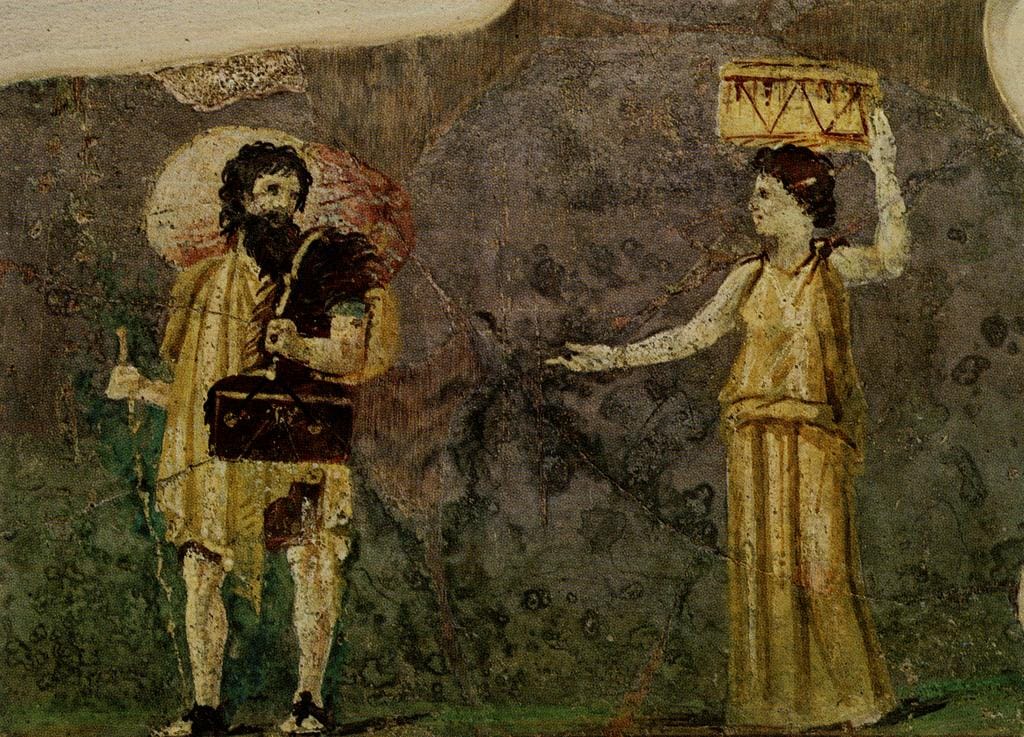
Around 300 BC a young woman from Thrace threatened to kill herself unless she was allowed to marry a penniless philosopher. She got her way, put on the Cynic's rough cloak, and went everywhere her husband went, including the drinking parties that respectable Greek women never attended. Hipparchia is the only woman to whom Diogenes Laertius, the ancient historian of philosophy, gives a life of her own.
A choice of husband
Hipparchia came from Maroneia on the north coast of the Aegean, and her brother Metrocles was already a follower of the Cynic Crates in Athens. Crates had been rich: he sold his property and gave the money away to live as a Cynic, owning nothing, in the manner of Diogenes.
Hipparchia, Diogenes Laertius says, fell in love with his teaching and his way of life, and turned down every other suitor: their wealth, their birth, their looks. Her parents begged Crates to talk her out of it. He tried everything, and then made his last argument.
ὁ μὲν νυμφίος οὗτος, ἡ δὲ κτῆσις αὕτη, πρὸς ταῦτα βουλεύου·“This is the bridegroom, here are his possessions; make your choice accordingly;”
She chose him.
A life in public
A respectable Greek wife lived mostly indoors, and did not dine with men who were not her relatives. Hipparchia dressed as Crates did, walked about the city with him and went with him to dinners. The Cynics' rule was that nothing natural is shameful, and they lived by it: the sceptic philosopher Sextus Empiricus, writing centuries later, still used Crates and Hipparchia making love in public as his standard example of a way of life opposed to ordinary custom.
Ancient tradition / legend Whether this happened as told, or grew in the retelling, cannot be known. The stories about the Cynics were told because they shocked, and each teller had reasons to sharpen them.
Dinner with a king
Diogenes Laertius tells one scene in detail. At a banquet given by Lysimachus, one of Alexander's generals who became a king, Hipparchia met the philosopher Theodorus, nicknamed "the Atheist", and beat him with a piece of logic. Whatever would not be called wrong if Theodorus did it, would not be called wrong if Hipparchia did it; Theodorus does no wrong when he hits himself; so Hipparchia does no wrong when she hits Theodorus.
Theodorus had no answer, so he tried to pull off her cloak. She was not upset. Then he quoted a line of Euripides at her: in the Bacchae, Queen Agave boasts that she has left her shuttles at the loom for greater things, hunting beasts with her bare hands. It was a sneer at a woman out of her place.
αὕτη ʼστὶν ἡ τὰς παρʼ ἱστοῖς ἐκλιποῦσα κερκίδας; ἐγώ, φησίν, εἰμί, Θεόδωρε· ἀλλὰ μὴ κακῶς σοι δοκῶ βεβουλεῦσθαι περὶ αὑτῆς, εἰ, τὸν χρόνον ὃν ἔμελλον ἱστοῖς προσαναλώσειν, τοῦτον εἰς παιδείαν κατεχρησάμην;“Is this she Who quitting woof and warp and comb and loom? she replied, It is I, Theodorus,—but do you suppose that I have been ill advised about myself, if instead of wasting further time upon the loom I spent it in education?”
What she stands for
Debated among scholars Hipparchia's own writings, if she wrote any, are lost, and we know her almost entirely from Diogenes Laertius, who wrote some five centuries after her. Historians read her life both as evidence that at least one Greek woman lived openly as a philosopher among men, and as a set of anecdotes shaped by the Cynics' love of provocation.
- c. 405 BCEuripides' Bacchae is first staged, after his death.
- 328–325 BCThe 113th Olympiad, when Crates "flourished" according to Diogenes Laertius. Debated among scholars
- c. 300 BCHipparchia marries Crates and lives as a Cynic. Debated among scholars
- 3rd c. ADDiogenes Laertius gives her a life in his Lives of the Philosophers.
Read it yourself
Sources
Ancient sources, in the library
Modern scholarship
- R. Bracht Branham and Marie-Odile Goulet-Cazé (eds.), The Cynics: The Cynic Movement in Antiquity and Its Legacy (Berkeley: University of California Press, 1996). Essays on the Cynics and what later ages made of them.
- William Desmond, Cynics (Stocksfield: Acumen, 2008). A clear introduction.
Every Greek quotation here is checked word for word against the edition it cites, and every translation against the translation named. Written 27 September 2026.