The Painted Stoa › Religion and belief
The Eleusinian Mysteriesτὰ Ἐλευσίνια μυστήρια
The secret kept by thousands for a thousand years
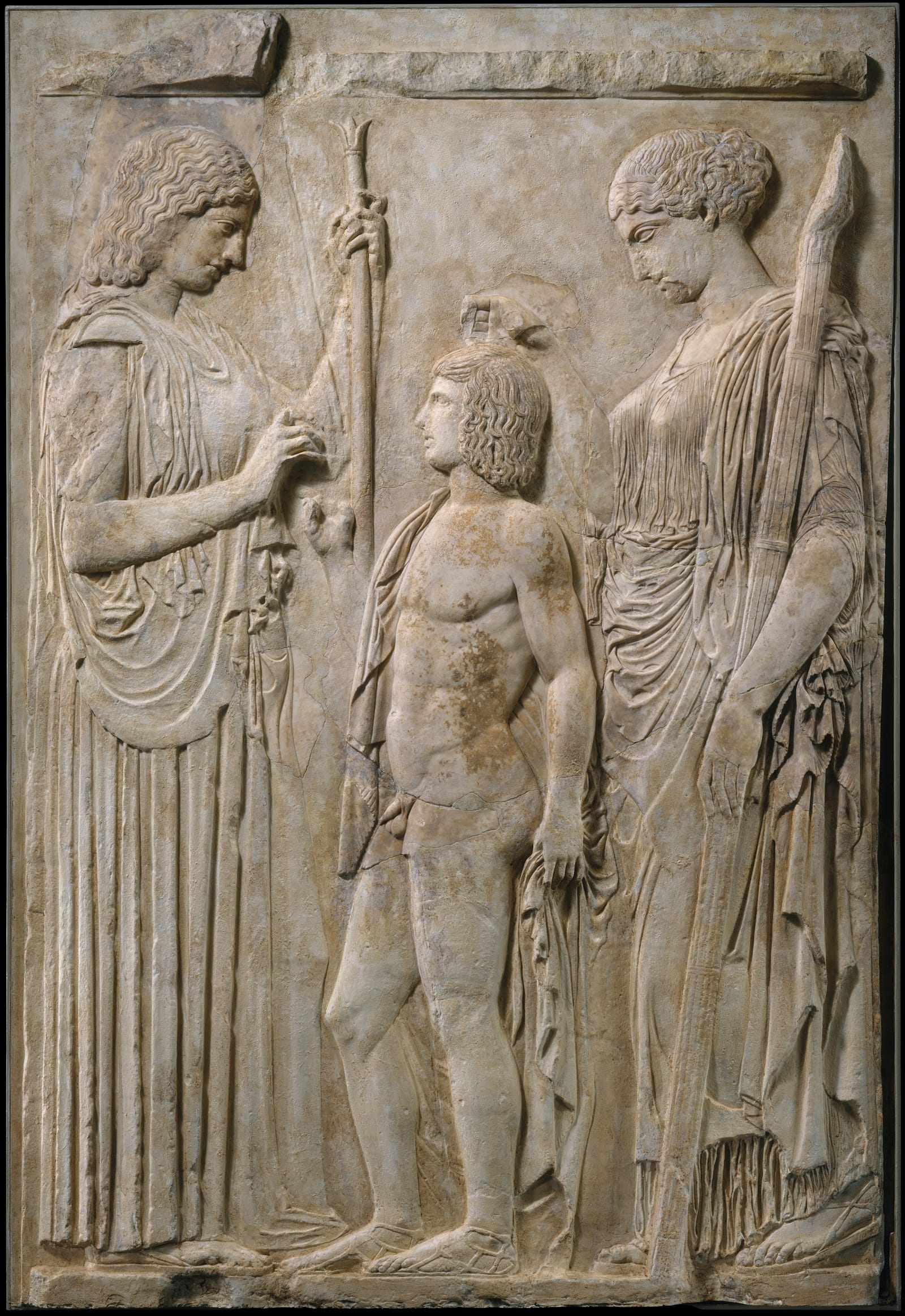
Every autumn for about a thousand years, crowds walked the fourteen miles from Athens to Eleusis to be initiated into the Mysteries of Demeter and her daughter Persephone. Men and women, citizens, foreigners and even slaves could take part, and many thousands did. They were promised a better lot after death. What happened in the great hall at Eleusis was never to be told, and it very nearly never was.
The story behind the rite
The Homeric Hymn to Demeter, composed probably in the seventh or sixth century BC, tells the myth. Hades carried off Demeter's daughter Persephone, the Maiden (Kore), to be queen of the dead. Demeter searched the earth in grief, came in disguise to Eleusis, and in her anger kept the crops from growing until Zeus let Persephone return for part of every year. Before leaving Eleusis, the goddess taught its leaders her rites.
ὄλβιος, ὃς τάδʼ ὄπωπεν ἐπιχθονίων ἀνθρώπων·
ὃς δʼ ἀτελὴς ἱερῶν ὅς τʼ ἄμμορος, οὔποθʼ ὁμοίων
αἶσαν ἔχει φθίμενός περ ὑπὸ ζόφῳ ἠερόεντι.“Happy is he among men upon earth who has seen these mysteries; but he who is uninitiate and who has no part in them, never has lot of like good things once he is dead, down in the darkness and gloom.”
For the Athenians, the Mysteries were one of the city's two great gifts to the world. The orator Isocrates, in the fourth century BC, put it this way: Demeter gave Attica two gifts, grain, which raised men above the beasts, and the rite, which gives those who share it "sweeter hopes" about death and all eternity.
Open to all, told to none
Well established Initiation was open to Greeks. At the start of the festival the heralds warned non-Greeks away, as they warned away murderers, and Herodotus says any Athenian or other Greek who wished could be initiated. Women and slaves took part. There were two grades: the mystai, first-time initiates, and, a year or more later, the epoptai, "those who have seen".
The secret was taken seriously. Aristotle mentions in passing that Aeschylus, accused of revealing the Mysteries in one of his plays, pleaded that he had not known the matter was secret. In 415 BC, as the Athenian fleet prepared to sail for Sicily, informers claimed that young aristocrats, among them the general Alcibiades, had performed the Mysteries in private houses as a drunken mockery. Alcibiades was recalled to stand trial, and slipped away on the way home, to go over to Sparta.
Six hundred years later Pausanias, describing Eleusis, stopped at the sanctuary wall: a dream forbade him to describe what was inside.
A ghostly procession
The festival began with a procession from Athens along the Sacred Way, with the cry of "Iacchus". Herodotus tells how in 480 BC, after the Persians had taken Attica and emptied it, two Greeks in the Persian camp saw a huge cloud of dust rising from Eleusis and heard the Iacchus cry, though no Athenian could be there. One explained it to the other.
τὴν δὲ ὁρτὴν ταύτην ἄγουσι Ἀθηναῖοι ἀνὰ πάντα ἔτεα τῇ Μητρὶ καὶ τῇ Κούρῃ, καὶ αὐτῶν τε ὁ βουλόμενος καὶ τῶν ἄλλων Ἑλλήνων μυεῖται· καὶ τὴν φωνὴν τῆς ἀκούεις ἐν ταύτῃ τῇ ὁρτῇ ἰακχάζουσι.“Every year the Athenians observe this festival for the Mother and the Maiden, and any Athenian or other Hellene who wishes is initiated. The voice which you hear is the ‘Iacchus’ they cry at this festival.”
Ancient tradition / legend The dust cloud was taken as a sign that the gods would destroy Xerxes' fleet, and a few days later it was destroyed at Salamis. Herodotus reports the story as he heard it.
What did they see?
The only descriptions come from Christian writers of the second and third centuries AD, hostile witnesses who wanted to expose the pagan rites. Clement of Alexandria gives what he calls the password of the Eleusinian initiates.
ἐνήστευσα, ἔπιον τὸν κυκεῶνα, ἔλαβον ἐκ κίστης, ἐργασάμενος ἀπεθέμην εἰς κάλαθον καὶ ἐκ καλάθου εἰς κίστην.“I fasted; I drank the kykeon; I took from the chest; having done my work, I put it into the basket, and from the basket into the chest.”
Hippolytus, quoting the writings of a Gnostic sect, says that the highest revelation, shown to the epoptai in silence, was an ear of grain, reaped, and that the chief priest, the hierophant, cried out at night under a great fire that the goddess had borne a holy child.
Debated among scholars How far to trust these writers is disputed. The kykeon, a drink of barley and water flavoured with pennyroyal, is also in the Homeric Hymn, where Demeter breaks her fast with it. The rest may be accurate, garbled, or taken from other cults. What the initiates felt, they did not write down.
The end
Debated among scholars The sanctuary was damaged when the Goths under Alaric invaded Greece in AD 396, and the Christian emperors had already banned pagan cult. The last hierophants are known from late sources, and exactly when the rites stopped is not certain.
- c. 1500 BCFirst buildings on the site of the later sanctuary at Eleusis. Debated among scholars
- 7th–6th c. BCThe Homeric Hymn to Demeter is composed. Debated among scholars
- 480 BCThe phantom Iacchus procession before Salamis, as Herodotus tells it. Ancient tradition / legend
- 415 BCAlcibiades is accused of profaning the Mysteries.
- c. AD 200Clement of Alexandria and, soon after, Hippolytus write against the Mysteries.
- AD 396Alaric's Goths invade Greece; the sanctuary is damaged. Debated among scholars
Read it yourself
Sources
Ancient sources, in the library
Modern scholarship
- George E. Mylonas, Eleusis and the Eleusinian Mysteries (Princeton: Princeton University Press, 1961). The sanctuary and its history, by one of its excavators.
- Walter Burkert, Ancient Mystery Cults (Cambridge, MA: Harvard University Press, 1987). Mystery cults compared, by a great historian of Greek religion.
Every Greek quotation here is checked word for word against the edition it cites, and every translation against the translation named. Written 27 September 2026.