The Painted Stoa › The beautiful
Homer's similesὡς δʼ ὅτε…
Windows onto a world at peace, opened in the middle of a war
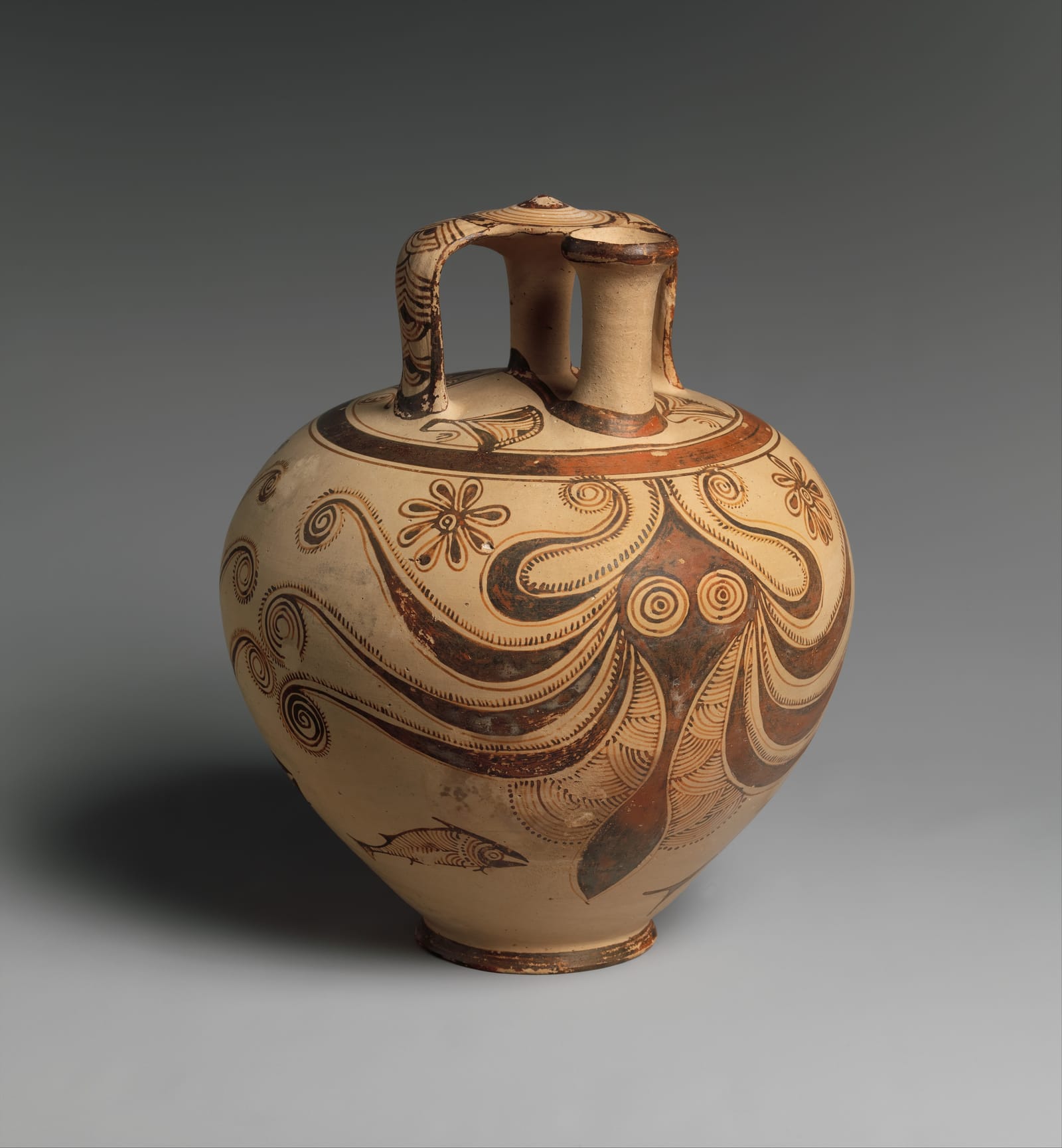
The Iliad is a poem about a few weeks of killing outside Troy. Yet again and again, just as the fighting is at its fiercest, Homer stops and says "as when…", and for a few lines we are somewhere else: on a mountain under the stars, in a snowstorm, beside a mother with a crying child. These long comparisons, the Homeric similes, are among the most beautiful things in Greek, and they are a good reason to learn to read it.
"As when…"
A simile compares one thing to another with "like" or "as". Homer's are often long, and they grow: the comparison starts with a single point in common and then unfolds into a scene of its own, with details the story does not need. Most begin with the same words, hōs d' hote, "and as when".
Leaves
When the Trojan ally Glaucus meets the Greek Diomedes on the battlefield, and Diomedes asks who he is, Glaucus answers with a simile about why the question hardly matters.
οἵη περ φύλλων γενεὴ τοίη δὲ καὶ ἀνδρῶν.
φύλλα τὰ μέν τʼ ἄνεμος χαμάδις χέει, ἄλλα δέ θʼ ὕλη
τηλεθόωσα φύει, ἔαρος δʼ ἐπιγίγνεται ὥρη·
ὣς ἀνδρῶν γενεὴ ἣ μὲν φύει ἣ δʼ ἀπολήγει.“Even as are the generations of leaves, such are those also of men. As for the leaves, the wind scattereth some upon the earth, but the forest, as it bourgeons, putteth forth others when the season of spring is come; even so of men one generation springeth up and another passeth away.”
Fires like stars
At the end of Book 8 the Trojans, winning for once, camp on the plain for the night. Homer describes their thousand watch-fires by comparing them to stars on a clear night.
ὡς δʼ ὅτʼ ἐν οὐρανῷ ἄστρα φαεινὴν ἀμφὶ σελήνην
φαίνετʼ ἀριπρεπέα, ὅτε τʼ ἔπλετο νήνεμος αἰθήρ·
ἔκ τʼ ἔφανεν πᾶσαι σκοπιαὶ καὶ πρώονες ἄκροι
καὶ νάπαι·“Even as in heaven about the gleaming moon the stars shine clear, when the air is windless, and forth to view appear all mountain peaks and high headlands and glades,”
The simile goes on: all the stars are seen, and the shepherd is glad at heart. So many were the fires between the ships and the river. The shepherd does not belong in the story at all, and that is the point: for a moment, the Trojans' hope looks like the calm of a shepherd's night.
A little girl
The most surprising similes compare heroes to the weakest people. When Patroclus comes to Achilles in tears, begging to be allowed to fight, Achilles teases him.
τίπτε δεδάκρυσαι Πατρόκλεες, ἠΰτε κούρη
νηπίη, ἥ θʼ ἅμα μητρὶ θέουσʼ ἀνελέσθαι ἀνώγει
εἱανοῦ ἁπτομένη, καί τʼ ἐσσυμένην κατερύκει,“Why, Patroclus, art thou bathed in tears, like a girl, a mere babe, that runneth by her mother's side and biddeth her take her up, and clutcheth at her gown, and hindereth her in her going,”
The simile ends with the child looking up at her mother in tears until she is picked up. Within a day Patroclus will be dead, and Achilles will weep for him.
Stones like snow
In Book 12 the two armies hurl stones at each other over the Greek wall, as thick as snow falling on a still winter day, when Zeus lulls the winds and covers the mountain peaks, the fields and the harbours, and only the edge of the sea keeps it off. The violence is turned into silence and whiteness.
The octopus
The Odyssey has fewer long similes, but some of the strangest. Shipwrecked and flung against the rocks of Scheria, Odysseus clings on until a wave tears him loose.
ὡς δʼ ὅτε πουλύποδος θαλάμης ἐξελκομένοιο
πρὸς κοτυληδονόφιν πυκιναὶ λάιγγες ἔχονται,
ὣς τοῦ πρὸς πέτρῃσι θρασειάων ἀπὸ χειρῶν
ῥινοὶ ἀπέδρυφθεν·“And as when an octopus is dragged from its den, and many pebbles cling to its suckers, so the skin of his strong hands was torn off against the rocks.”
Homer's word for the octopus, polypous, means "many-foot". Anyone who has pulled an octopus off a rock knows how exactly, and how painfully, the picture fits.
Why they matter
Debated among scholars Scholars have argued about where the similes come from, and how they fit the oral tradition in which the poems were composed. Many of them draw on a world of farms, flocks, weather and wild animals that seems closer to the poet's audience than the heroes' world. What nobody disputes is their effect: they let the listener see the war from outside, and they are some of the most imitated passages in European poetry.
- 8th–7th c. BCThe Iliad and the Odyssey take their final form. Debated among scholars
- 6th c. BCHomer is recited at the Panathenaic festival in Athens, by later tradition from the time of Hipparchus. Debated among scholars
- c. 19 BCVirgil's Aeneid reworks Homer's leaves, and many other similes.
- 1667Milton's Paradise Lost: "Thick as autumnal leaves".
Read it yourself
Sources
Ancient sources, in the library
Modern scholarship
- Carroll Moulton, Similes in the Homeric Poems (Hypomnemata 49) (Göttingen: Vandenhoeck & Ruprecht, 1977). How the similes are placed and linked across each poem.
- William C. Scott, The Oral Nature of the Homeric Simile (Mnemosyne Supplement 28) (Leiden: Brill, 1974). The similes as part of an oral tradition.
Every Greek quotation here is checked word for word against the edition it cites, and every translation against the translation named. Written 27 September 2026.