Drugs and poisonsτὰ φάρμακα
Healing herbs, killing cups and the smoke of the Scythians
The Greeks had one word for a medicine, a poison and a magic spell: pharmakon. Homer's Helen drops an Egyptian drug into the wine that makes men forget every grief. A botanist gave doses for a root that makes a man think himself beautiful, then see visions, then go mad, then die. Athens executed its citizens with hemlock, and once ran out of it. Xenophon's army was laid flat by poisoned honey, and Herodotus describes the Scythians howling with pleasure in a tent full of hemp smoke. This is what the sources say about drugs, and what modern science has made of it.
One word, three meanings
LSJ, the great dictionary of ancient Greek, gives pharmakon first as a "drug, whether healing or noxious", then as a medicine, a charm or spell, and a poison. The word does not take sides: a pharmakon is anything that changes a body or a mind from outside, and whether it helps or harms depends on the dose, the maker and the gods.
Homer knew this. When Helen wants to lift the gloom from Menelaus' hall, she reaches for a drug she was given in Egypt, a land whose earth bears the "greatest store of drugs, many that are healing when mixed, and many that are baneful".
αὐτίκʼ ἄρʼ εἰς οἶνον βάλε φάρμακον, ἔνθεν ἔπινον,
νηπενθές τʼ ἄχολόν τε, κακῶν ἐπίληθον ἁπάντων.
ὃς τὸ καταβρόξειεν, ἐπὴν κρητῆρι μιγείη,
οὔ κεν ἐφημέριός γε βάλοι κατὰ δάκρυ παρειῶν,“Straightway she cast into the wine of which they were drinking a drug to quiet all pain and strife, and bring forgetfulness of every ill. Whoso should drink this down, when it is mingled in the bowl, would not in the course of that day let a tear fall down over his cheeks,”
Ancient tradition / legend No one knows what, if anything real, stood behind Helen's drug; Homer names no plant. His other drug-giver, the goddess Circe, stirs cheese, barley and honey into Pramnian wine and mixes in baneful drugs that turn Odysseus' men into pigs. The antidote is a plant the gods call moly, black at the root and with a flower like milk.
The root-cutters
Most drugs came from plants, gathered by professional rhizotomoi, "root-cutters". The ninth book of Theophrastus' Enquiry into Plants, written by Aristotle's successor at the Lyceum, is about plant juices and the powers of herbs, and it records what the root-cutters did. Some of it he found hard to believe. For the mandrake, he reports, you draw three circles round the plant with a sword and cut it facing west, while a second person dances round it talking about sex.
περιγράφειν δὲ καὶ τὸν μανδραγόραν εἰς τρὶς ξίφει, τέμνειν δὲ πρὸς ἑσπέραν βλέποντα. τὸν δ᾿ ἕτερον κύκλῳ περιορχεῖσθαι καὶ λέγειν ὡς πλεῖστα περὶ ἀφροδισίων.“They say too that you should draw three circles round the mandrake with a sword, and cut it facing west; and that a second person should dance round it in a ring and say as much as he can about sex.”
Theophrastus adds that such rites look like embellishments. He is more precise about doses. Of the plant he calls the "maddening strychnos", he writes:
δίδοται δ᾿ αὐτῆς, ἐὰν μὲν ὥστε παίζειν καὶ δοκεῖν ἑαυτῷ κάλλιστον εἶναι, δραχμὴ σταθμῷ· ἐὰν δὲ μᾶλλον μαίνεσθαι καὶ φαντασίας τινὰς φαίνεσθαι, δύο δραχμαί· ἐὰν δ᾿ ὥστε μὴ παύεσθαι μαινόμενον τρεῖς, καὶ συμπαραμιγνύναι φασὶν ὀπὸν κενταυρίου· ἐὰν δὲ ὥστε ἀποκτεῖναι, τέτταρες.“Of its root, one drachma's weight is given if a man is to play about and think himself the most beautiful of men; two drachmas, if he is to be madder and see visions; three, if he is to be mad for good, and with this, they say, the juice of centaury is mixed in; four, if he is to die.”
Debated among scholars Which plant this was is not certain. LSJ identifies the maddening strychnos as thorn-apple, Datura stramonium, following the later herbal of Dioscorides; identifications of ancient plant names from descriptions like these are often insecure.
Hemlock, the city's poison
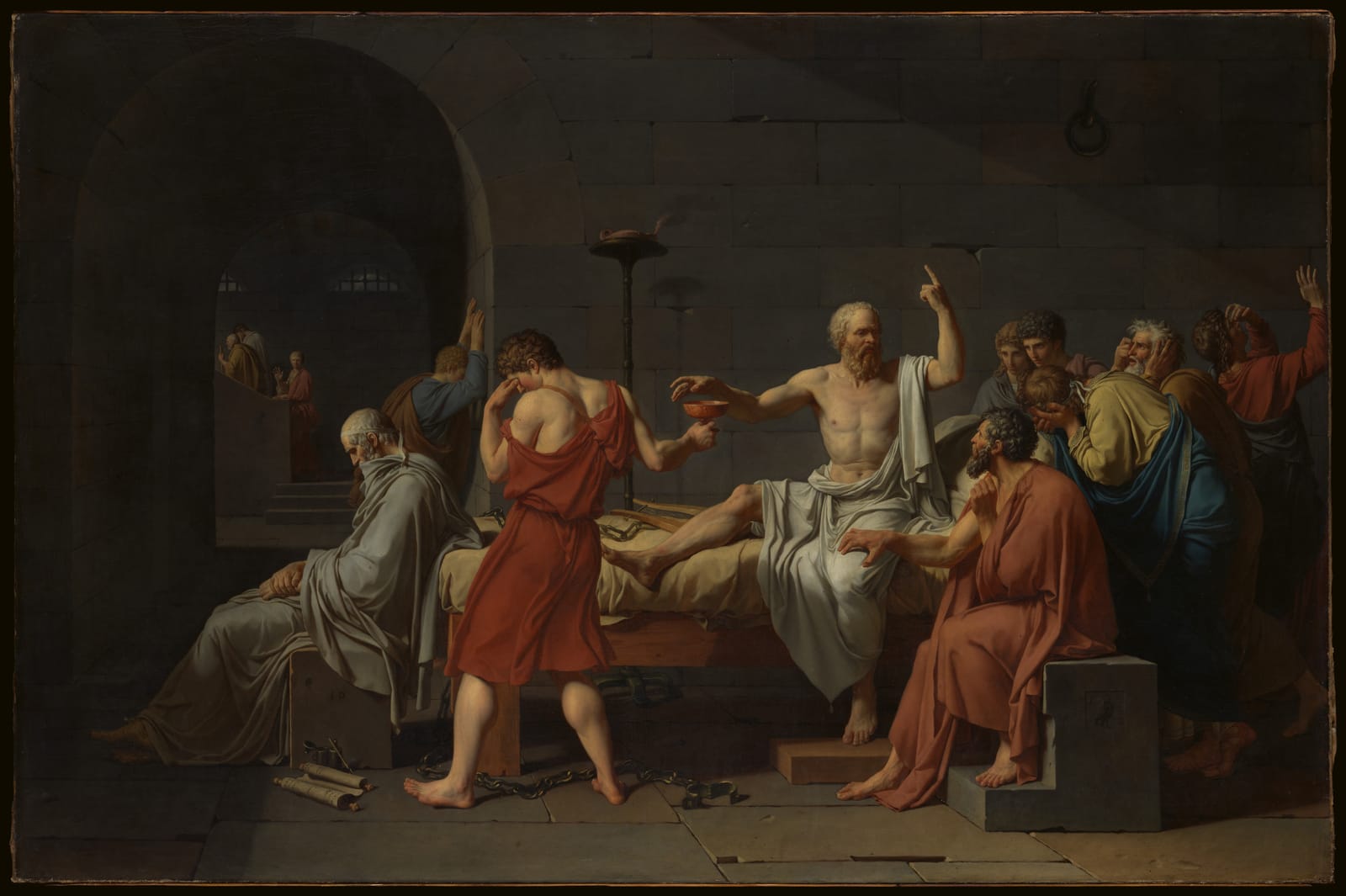
At Athens a condemned prisoner could be put to death with hemlock, pounded and given to him in a cup by a public slave. Plato's account of the death of Socrates in 399 BC never names the plant: he calls it simply "the drug", and describes the attendant pressing Socrates' feet and legs as the numbness climbed towards his heart.
Debated among scholars Doctors and scholars have argued over whether hemlock could kill so quietly. In the 1970s the classicist Christopher Gill and the pathologist William Ober argued that real hemlock poisoning is far more violent, and that Plato softened it. Enid Bloch replied, from the medical literature on poison hemlock (Conium maculatum), that it can produce exactly the rising paralysis with a clear mind that Plato describes.
Others met the cup with a joke. When the Thirty Tyrants forced Theramenes to drink hemlock in 404 BC, he is said to have flicked out the last drops as if playing kottabos, the drinking-party game, with a toast: "Here's to the health of my beloved Critias", the man who had had him condemned. In 318 BC the general Phocion was sentenced with several friends, and the poison ran out.
πεπωκότων δὲ ἤδη πάντων τὸ φάρμακον ἐπέλιπε, καὶ ὁ δημόσιος οὐκ ἔφη τρίψειν ἕτερον, εἰ μὴ λάβοι δώδεκα δραχμάς, ὅσου τὴν ὁλκὴν ὠνεῖται.“But when all the rest had drunk of it, the drug ran short, and the executioner refused to bruise another portion unless he were paid twelve drachmas, which was the price of the weight required.”
Phocion had a friend pay the man, asking whether at Athens one could not even die for free.
The doctor's promise
The Hippocratic Oath, sworn by Apollo the physician, Asclepius, Health and All-heal, draws a line between the two faces of the pharmakon:
οὐ δώσω δὲ οὐδὲ φάρμακον οὐδενὶ αἰτηθεὶς θανάσιμον,“I will give no deadly medicine to any one if asked,”
Mad honey
In 401–400 BC Xenophon led the ten thousand Greek soldiers of the Anabasis north through the mountains to the Black Sea. In the villages of the Colchians, two days' march from Trapezus, they found beehives, and ate the honey.
τὰ δὲ σμήνη πολλὰ ἦν αὐτόθι, καὶ τῶν κηρίων ὅσοι ἔφαγον τῶν στρατιωτῶν πάντες ἄφρονές τε ἐγίγνοντο καὶ ἤμουν καὶ κάτω διεχώρει αὐτοῖς καὶ ὀρθὸς οὐδεὶς ἐδύνατο ἵστασθαι, ἀλλʼ οἱ μὲν ὀλίγον ἐδηδοκότες σφόδρα μεθύουσιν ἐῴκεσαν, οἱ δὲ πολὺ μαινομένοις, οἱ δὲ καὶ ἀποθνῄσκουσιν.“but the swarms of bees in the neighbourhood were numerous, and the soldiers who ate of the honey all went off their heads, and suffered from vomiting and diarrhoea, and not one of them could stand up, but those who had eaten a little were like people exceedingly drunk, while those who had eaten a great deal seemed like crazy, or even, in some cases, dying men.”
Nobody died. On the next day, at about the hour they had eaten, they came to their senses, and on the third and fourth day they got up "as if from a drugging".
Well established This is "mad honey", made by bees from the nectar of rhododendrons, especially Rhododendron ponticum and R. luteum, which contains toxins called grayanotoxins. It is still produced in the eastern Black Sea region of Turkey. A modern medical review opens with Xenophon's account and notes that in people the poisoning is rarely fatal, just as he found.
Hemp in the tent
Herodotus describes what the Scythians, the nomads north of the Black Sea, did after a burial. They set up three poles leaning together, stretched felt mats around them, put red-hot stones in a dish in the middle, and crawled in with hemp seed.
ταύτης ὦν οἱ Σκύθαι τῆς καννάβιος τὸ σπέρμα ἐπεὰν λάβωσι, ὑποδύνουσι ὑπὸ τοὺς πίλους, καὶ ἔπειτα ἐπιβάλλουσι τὸ σπέρμα ἐπὶ τοὺς διαφανέας λίθους τῷ πυρί· τὸ δὲ θυμιᾶται ἐπιβαλλόμενον καὶ ἀτμίδα παρέχεται τοσαύτην ὥστε Ἑλληνικὴ οὐδεμία ἄν μιν πυρίη ἀποκρατήσειε. οἱ δὲ Σκύθαι ἀγάμενοι τῇ πυρίῃ ὠρύονται.“The Scythians then take the seed of this hemp and, crawling in under the mats, throw it on the red-hot stones, where it smoulders and sends forth such fumes that no Greek vapor-bath could surpass it. The Scythians howl in their joy at the vapor-bath.”
Well established Archaeology has found the kit. In the frozen tombs of Pazyryk in the Altai mountains, of the 5th and 4th centuries BC, Russian excavators found a set of poles, a bronze vessel filled with stones and hemp seeds, and a covering, as Penn Museum's Expedition magazine describes. In 2019 chemists analysing wooden braziers from the Jirzankal cemetery in the Pamirs, of about 500 BC, found the chemical traces of cannabis with more of its intoxicating compound than wild plants usually have: the earliest clear evidence of cannabis burned for its effect on the mind.
Debated among scholars Herodotus calls it a vapour bath, and says the Scythians used it instead of washing. Whether he understood what the smoke did to them, or saw it only as a strange way of getting clean, he does not say.
And the Mysteries?
The drink of the Eleusinian Mysteries, the kykeon, was made of barley, water and pennyroyal, according to the Homeric Hymn to Demeter. In 1978 R. Gordon Wasson, the chemist Albert Hofmann (who had first made LSD) and Carl Ruck proposed that it also contained ergot, a fungus of grain with mind-altering alkaloids.
Debated among scholars It remains a hypothesis. The ancient sources name no drug in the kykeon, and the initiates did not describe what they felt. The same is true of the vapour said to inspire the priestess at Delphi.
- c. 700 BCThe Odyssey, with Helen's Egyptian drug and Circe's, takes the form we know. Debated among scholars
- c. 500 BCCannabis is burned in wooden braziers at funerals in the Jirzankal cemetery, in the Pamirs.
- 5th–4th c. BCThe Pazyryk burials in the Altai, with poles, a covering and a bronze vessel of stones and hemp seed.
- 5th c. BCHerodotus describes the Scythians' hemp tent.
- 404 BCTheramenes drinks hemlock on the orders of the Thirty.
- 401–400 BCXenophon's soldiers eat mad honey near Trapezus.
- 399 BCSocrates drinks the poison in prison.
- 318 BCPhocion is executed; the hemlock runs out.
- late 4th–early 3rd c. BCTheophrastus writes his Enquiry into Plants.
Read it yourself
- Homer, Odyssey 4.219–232Helen's drug, and Egypt, the land of drugs.Open in the Scroll →
- Herodotus 4.73–75The Scythians' funeral, tent and hemp.Open in the Scroll →
- Xenophon, Anabasis 4.8.19–21The army and the mad honey.Open in the Scroll →
- Plato, Phaedo 117a–118aThe death of Socrates, step by step.Open in the Scroll →
- Plutarch, Phocion 36An execution by hemlock, and its price.Open in the Scroll →
Sources
Ancient sources, in the library
- Homer, Odyssey 4.219–232
- Homer, Odyssey 10.233–306
- Plato, Phaedrus 274c–275b
- Theophrastus, Enquiry into Plants 9.8.7–8
- Theophrastus, Enquiry into Plants 9.11.5–6
- Theophrastus, Enquiry into Plants 9.16.8–9
- Plato, Phaedo 117a–118a
- Xenophon, Hellenica 2.3.56
- Plutarch, Phocion 36
- Strabo 10.5.6
- The Hippocratic Oath
- Xenophon, Anabasis 4.8.19–21
- Herodotus 4.73–75
- Homeric Hymn to Demeter 206–211
Modern scholarship
- Michael A. Rinella, Pharmakon: Plato, Drug Culture, and Identity in Ancient Athens (Lanham, MD: Lexington Books, 2010). Drugs, ecstasy and the word pharmakon in classical Athens, and in Plato.
- Theophrastus, translated by Arthur F. Hort, Enquiry into Plants, Volume II: Books 6–9 (Loeb Classical Library 79) (Cambridge, MA: Harvard University Press, 1916). Book 9 of the Enquiry, on juices and medicinal herbs, with a facing translation.
- Enid Bloch, Hemlock Poisoning and the Death of Socrates: Did Plato Tell the Truth?, in T. C. Brickhouse and N. D. Smith (eds.), The Trial and Execution of Socrates: Sources and Controversies (Oxford: Oxford University Press, 2002). The case that Plato described hemlock poisoning accurately.
- S. A. Jansen, I. Kleerekooper, Z. L. M. Hofman, I. F. P. M. Kappen, A. Stary-Weinzinger and M. A. G. van der Heyden, Grayanotoxin Poisoning: ‘Mad Honey Disease’ and Beyond (Cardiovascular Toxicology 12, 208–215, 2012). A medical review of mad honey, from Xenophon to modern cases.
- Sergei I. Rudenko, translated by M. W. Thompson, Frozen Tombs of Siberia: The Pazyryk Burials of Iron Age Horsemen (Berkeley and Los Angeles: University of California Press, 1970). The excavator's own account of the Pazyryk burials.
- Meng Ren, Zihua Tang, Xinhua Wu, Robert Spengler, Hongen Jiang, Yimin Yang and Nicole Boivin, The origins of cannabis smoking: Chemical residue evidence from the first millennium BCE in the Pamirs (Science Advances 5, eaaw1391, 2019). The Jirzankal braziers and their chemical traces.
- R. Gordon Wasson, Albert Hofmann and Carl A. P. Ruck, The Road to Eleusis: Unveiling the Secret of the Mysteries (New York: Harcourt Brace Jovanovich, 1978). The ergot hypothesis for the kykeon.
Every Greek quotation here is checked word for word against the edition it cites, and every translation against the translation named. Written 30 September 2026.