Love, sex and marriageἔρως καὶ γάμος
Wedding torches, a poet's fever, lovers' customs and the law on adultery
A Greek marriage was a deal between two households, made so that a man would have legitimate children to inherit his house. The bride could be a young teenager and the groom twice her age. Yet the same people wrote one of the most famous poems of desire ever written, told a myth in which lovers are two halves of one creature looking for each other, and argued about the proper way for a man to court a boy. Athenian law let a husband kill a man caught in bed with his wife, and a comedy had the women of Greece stop a war by refusing sex. Here is what the texts say, and where they need reading with care.
A contract between two houses
The frankest statement of what an Athenian marriage was for comes from a lawsuit. In the mid-4th century BC Apollodorus prosecuted Neaera, whom he accused of having been a courtesan and of living as the wife of an Athenian citizen although she was a foreigner, which the law forbade. The speech survives among the works of Demosthenes. Explaining what marriage means, the prosecutor tells the jury:
τὰς μὲν γὰρ ἑταίρας ἡδονῆς ἕνεκʼ ἔχομεν, τὰς δὲ παλλακὰς τῆς καθʼ ἡμέραν θεραπείας τοῦ σώματος, τὰς δὲ γυναῖκας τοῦ παιδοποιεῖσθαι γνησίως καὶ τῶν ἔνδον φύλακα πιστὴν ἔχειν.“Mistresses we keep for the sake of pleasure, concubines for the daily care of our persons, but wives to bear us legitimate children and to be faithful guardians of our households.”
Debated among scholars This line is often quoted as if it summed up Athenian men's lives. It is a prosecutor's point, made to win a case about legitimate children, and it says more about what the law cared about than about how husbands and wives felt.
When, and whom
The poet Hesiod gave the traditional advice: a man should marry at about thirty, and take a young wife who has been grown up for four years.
ὡραῖος δὲ γυναῖκα τεὸν ποτὶ οἶκον ἄγεσθαι,
μήτε τριηκόντων ἐτέων μάλα πόλλʼ ἀπολείπων
μήτʼ ἐπιθεὶς μάλα πολλά· γάμος δέ τοι ὥριος οὗτος·
ἡ δὲ γυνὴ τέτορʼ ἡβώοι, πέμπτῳ δὲ γαμοῖτο.
παρθενικὴν δὲ γαμεῖν, ὥς κʼ ἤθεα κεδνὰ διδάξῃς.“Bring home a wife to your house when you are of the right age, while you are not far short of thirty years nor much above; this is the right age for marriage. Let your wife have been grown up four years, and marry her in the fifth. Marry a maiden, so that you can teach her careful ways,”
Much later Aristotle, planning an ideal city, set the best ages at about eighteen for women and thirty-seven for men. Real brides could be younger. In Xenophon's Oeconomicus the wealthy Ischomachus describes the girl he married:
καὶ τί ἄν, ἔφη, ὦ Σώκρατες, ἐπισταμένην αὐτὴν παρέλαβον, ἣ ἔτη μὲν οὔπω πεντεκαίδεκα γεγονυῖα ἦλθε πρὸς ἐμέ, τὸν δʼ ἔμπροσθεν χρόνον ἔζη ὑπὸ πολλῆς ἐπιμελείας ὅπως ὡς ἐλάχιστα μὲν ὄψοιτο, ἐλάχιστα δʼ ἀκούσοιτο, ἐλάχιστα δʼ ἔροιτο;“Why, what knowledge could she have had, Socrates, when I took her for my wife? She was not yet fifteen years old when she came to me, and up to that time she had lived in leading-strings, seeing, hearing and saying as little as possible.”
The wedding
The wedding itself was a night-time procession. On the shield that Hephaestus makes for Achilles in the Iliad, one of the scenes is a city at peace with weddings in it:
ἐν τῇ μέν ῥα γάμοι τʼ ἔσαν εἰλαπίναι τε,
νύμφας δʼ ἐκ θαλάμων δαΐδων ὕπο λαμπομενάων
ἠγίνεον ἀνὰ ἄστυ, πολὺς δʼ ὑμέναιος ὀρώρει·“In the one there were marriages and feastings, and by the light of the blazing torches they were leading the brides from their bowers through the city, and loud rose the bridal song.”
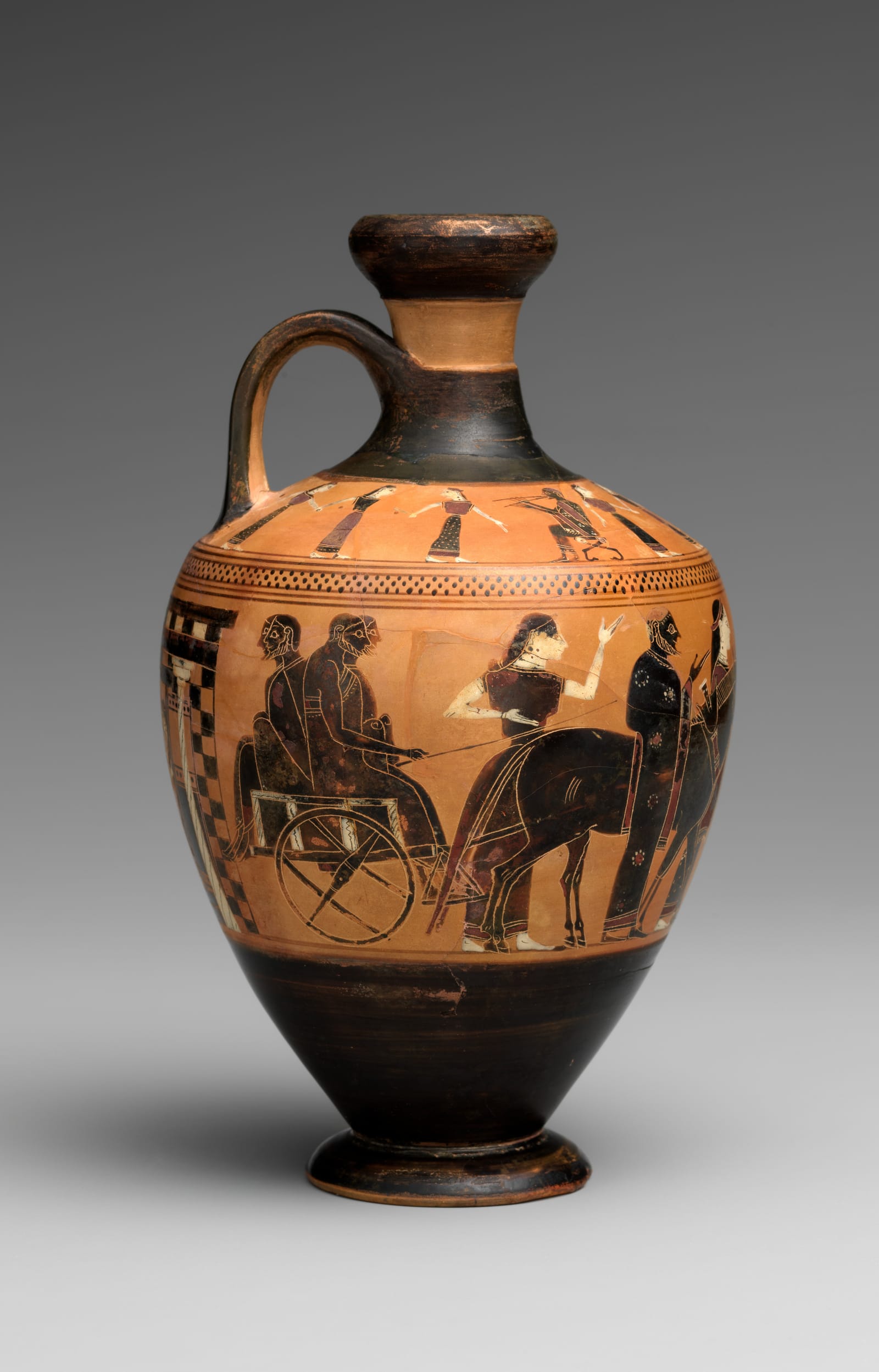
Well established The oil flask above, painted by the Amasis Painter between about 550 and 530 BC, is the earliest and most complete picture of an Athenian wedding, according to the Metropolitan Museum, which owns it. The bride and groom ride in a cart drawn by two donkeys, a woman walks ahead with two torches to light the way, and the procession heads for the groom's house, where a woman, probably his mother, waits at the door. Painted vases like this one are the main evidence for the stages of the ceremony.
Desire
Sappho, writing on Lesbos around 600 BC, describes watching a woman she loves laugh with a man, "equal to the gods", who sits opposite her. What follows is a list of symptoms. We owe the poem to the critic known as Longinus, who quoted it in *On the Sublime* as a model of how to choose and combine details.
ἀλλὰ κὰμ μὲν γλῶσσα ἔαγε· λεπτὸν δ᾽
αὐτίκα χρῶ πῦρ ὑπαδεδρόμακεν·
ὀππάτεσσι δ’ οὐδὲν ὅρημ̓, ἐπιρρόμ-
βεισι δ’ ἄκουαι·
κὰδ δέ μ’ ἱδρὼς κακχέεται, τρόμος δὲ
παῖσαν ἀγρεῖ, χλωροτέρα δὲ ποίας
ἐμμί· τεθνάκην δ’ ὀλίγω ʼπιδεύην
φαίνομαι.“No: my tongue is broken, a thin fire has at once run under my skin, my eyes see nothing, my ears hum, sweat pours down me, trembling seizes all of me, I am greener than grass, and I seem to myself little short of dying.”
In Plato's Symposium the comic poet Aristophanes explains love with a myth. Humans were once round creatures with four arms and four legs, until Zeus cut them in half; ever since, each half has searched for the other. Some of the original creatures were male and female, some male and male, some female and female, so the myth accounts, in its comic way, for men who love women, men who love men and women who love women.
ἔστι δὴ οὖν ἐκ τόσου ὁ ἔρως ἔμφυτος ἀλλήλων τοῖς ἀνθρώποις καὶ τῆς ἀρχαίας φύσεως συναγωγεὺς καὶ ἐπιχειρῶν ποιῆσαι ἓν ἐκ δυοῖν καὶ ἰάσασθαι τὴν φύσιν τὴν ἀνθρωπίνην.“Thus anciently is mutual love ingrained in mankind, reassembling our early estate and endeavoring to combine two in one and heal the human sore.”
Men and boys
In Athens and many other cities, an accepted form of love was the courtship of an adolescent boy by an adult man, the erastes ("lover") and the eromenos ("beloved"). It appears on painted vases, in poetry and in the law courts; K. J. Dover's study of this evidence, published in 1978, is the classic account.
The customs varied from city to city, and even Greeks found them confusing. In the Symposium, Pausanias says that in Elis and Boeotia it was simply thought honourable for a boy to "gratify" his lover, that in Ionia, under Persian rule, it was thought disgraceful, and that the Athenian custom was complicated. Athenians honoured as the founders of their freedom two lovers, Harmodius and Aristogeiton, who killed the tyrant's brother in 514 BC. Thucydides insists that a love affair was the cause.
Debated among scholars How the courtship worked in practice, how much of it was sexual, and what the boys themselves thought, are argued over. Nearly all the evidence was written or painted by and for adult men.
Unfaithful husbands, unfaithful wives
A wife could leave her husband, but the divorce had to be registered, in person, with a magistrate. Plutarch tells how Hipparete, wife of the brilliant and dissolute Alcibiades, tried to divorce him:
τοῦ δʼ Ἀλκιβιάδου μὴ φροντίζοντος, ἀλλὰ τρυφῶντος, ἔδει τὸ τῆς ἀπολείψεως γράμμα παρὰ τῷ ἄρχοντι θέσθαι, μὴ διʼ ἑτέρων, ἀλλʼ αὐτὴν παροῦσαν. ὡς οὖν παρῆν τοῦτο πράξουσα κατὰ τὸν νόμον, ἐπελθὼν ὁ Ἀλκιβιάδης καὶ συναρπάσας αὐτὴν ἀπῆλθε διʼ ἀγορᾶς οἴκαδε κομίζων, μηδενὸς ἐναντιωθῆναι μηδʼ ἀφελέσθαι τολμήσαντος.“Alcibiades did not mind this, but continued his wanton ways, and so she had to put in her plea for divorce to the magistrate, and that not by proxy, but in her own person. On her appearing publicly to do this, as the law required, Alcibiades came up and seized her and carried her off home with him through the market place, no man daring to oppose him or take her from him.”
The law on adultery was harsh on the man. In a speech Lysias wrote for Euphiletus, an Athenian on trial for killing his wife's lover Eratosthenes, the defendant says he caught Eratosthenes in the act, and that the law allowed a husband to kill him there. He describes his small house, where he had given the ground floor to his wife so that she could see to the baby at night:
οἰκίδιον ἔστι μοι διπλοῦν, ἴσα ἔχον τὰ ἄνω τοῖς κάτω κατὰ τὴν γυναικωνῖτιν καὶ κατὰ τὴν ἀνδρωνῖτιν. ἐπειδὴ δὲ τὸ παιδίον ἐγένετο ἡμῖν, ἡ μήτηρ αὐτὸ ἐθήλαζεν· ἵνα δὲ μή, ὁπότε λοῦσθαι δέοι, κινδυνεύῃ κατὰ τῆς κλίμακος καταβαίνουσα, ἐγὼ μὲν ἄνω διῃτώμην, αἱ δὲ γυναῖκες κάτω.“my dwelling is on two floors, the upper being equal in space to the lower, with the women’s quarters above and the men’s below. When the child was born to us, its mother suckled it; and in order that, each time that it had to be washed, she might avoid the risk of descending by the stairs, I used to live above, and the women below.”
Debated among scholars Euphiletus goes on to argue that the law punished a seducer with death but a rapist only with double damages, because seduction corrupted a wife's mind and made the children's father uncertain. Historians used to take this as the Athenian view. Edward Harris has argued that it is special pleading by a man on trial for his life, not a statement of what Athenians generally believed.
The sex strike
In 411 BC, twenty years into the war with Sparta, Aristophanes staged Lysistrata. Its heroine persuades the women of Greece to refuse their husbands until the men make peace, and administers an oath over a bowl of wine. Her friend Calonice has to repeat it line by line.
οὐκ ἔστιν οὐδεὶς οὔτε μοιχὸς οὔτʼ ἀνήρ—
οὐκ ἔστιν οὐδεὶς οὔτε μοιχὸς οὔτʼ ἀνήρ—
ὅστις πρὸς ἐμὲ πρόσεισιν ἐστυκώς. λέγε.
ὅστις πρὸς ἐμὲ πρόσεισιν ἐστυκώς. παπαῖ
ὑπολύεταί μου τὰ γόνατʼ ὦ Λυσιστράτη.“LYSISTRATA: There is no one, no lover and no husband… CALONICE: There is no one, no lover and no husband… LYSISTRATA: …who shall come near me with an erection. Say it! CALONICE: …who shall come near me with an erection. Oh dear, my knees are giving way, Lysistrata!”
- c. 700 BCHesiod's Works and Days advises a man to marry at about thirty. Debated among scholars
- c. 600 BCSappho writes her poems on Lesbos.
- c. 550–530 BCThe Amasis Painter paints the earliest full picture of an Athenian wedding.
- 514 BCThe lovers Harmodius and Aristogeiton kill Hipparchus, the tyrant's brother.
- 411 BCAristophanes' Lysistrata.
- 4th c. BCPlato's Symposium and Xenophon's Oeconomicus.
- mid-4th c. BCThe prosecution of Neaera.
Read it yourself
- Lysias 1.6–27A husband tells how he found out, in the defence speech for his life.Open in the Scroll →
- Xenophon, Oeconomicus 7A husband sets out to train his young wife.Open in the Scroll →
- Plato, Symposium 189c–193dAristophanes' myth of the two halves.Open in the Scroll →
- Plutarch, Alcibiades 8.3–5A wife's attempt at divorce.Open in the Scroll →
- [Demosthenes] 59.16–17The law on marrying a foreigner, read out in court.Open in the Scroll →
Sources
Ancient sources, in the library
- Hesiod, Works and Days 695–705
- Homer, Iliad 18.490–496
- Longinus, On the Sublime 10.1–3 (Sappho, fragment 31)
- Plato, Symposium 182a–d
- Plato, Symposium 189c–193d
- Xenophon, Oeconomicus 7.5–6
- Aristotle, Politics 7.1335a
- Plutarch, Alcibiades 8.3–5
- Lysias 1.9–33
- Aristophanes, Lysistrata 212–236
- [Demosthenes] 59.16
- Thucydides 6.54–59
- [Demosthenes] 59.122
Modern scholarship
- John H. Oakley and Rebecca H. Sinos, The Wedding in Ancient Athens (Madison: University of Wisconsin Press, 1993). The Athenian wedding, stage by stage, from the painted vases.
- K. J. Dover, Greek Homosexuality (Cambridge, MA: Harvard University Press, 1978). The evidence of vases, poetry, Plato and the law courts.
- Konstantinos A. Kapparis, Apollodoros ‘Against Neaira’ [D. 59]: Edited with Introduction, Translation and Commentary (Berlin and New York: De Gruyter, 1999). The speech against Neaera, with its legal background.
- Edward M. Harris, Did the Athenians Regard Seduction as a Worse Crime than Rape? (Classical Quarterly 40, 370–377, 1990). Why Lysias 1 is not a guide to Athenian views on seduction and rape.
Every Greek quotation here is checked word for word against the edition it cites, and every translation against the translation named. Written 30 September 2026.