The Painted Stoa › Archaeology
Knossos and the labyrinthΚνωσός
Minos' city in legend, and the palace Arthur Evans dug up and rebuilt in concrete
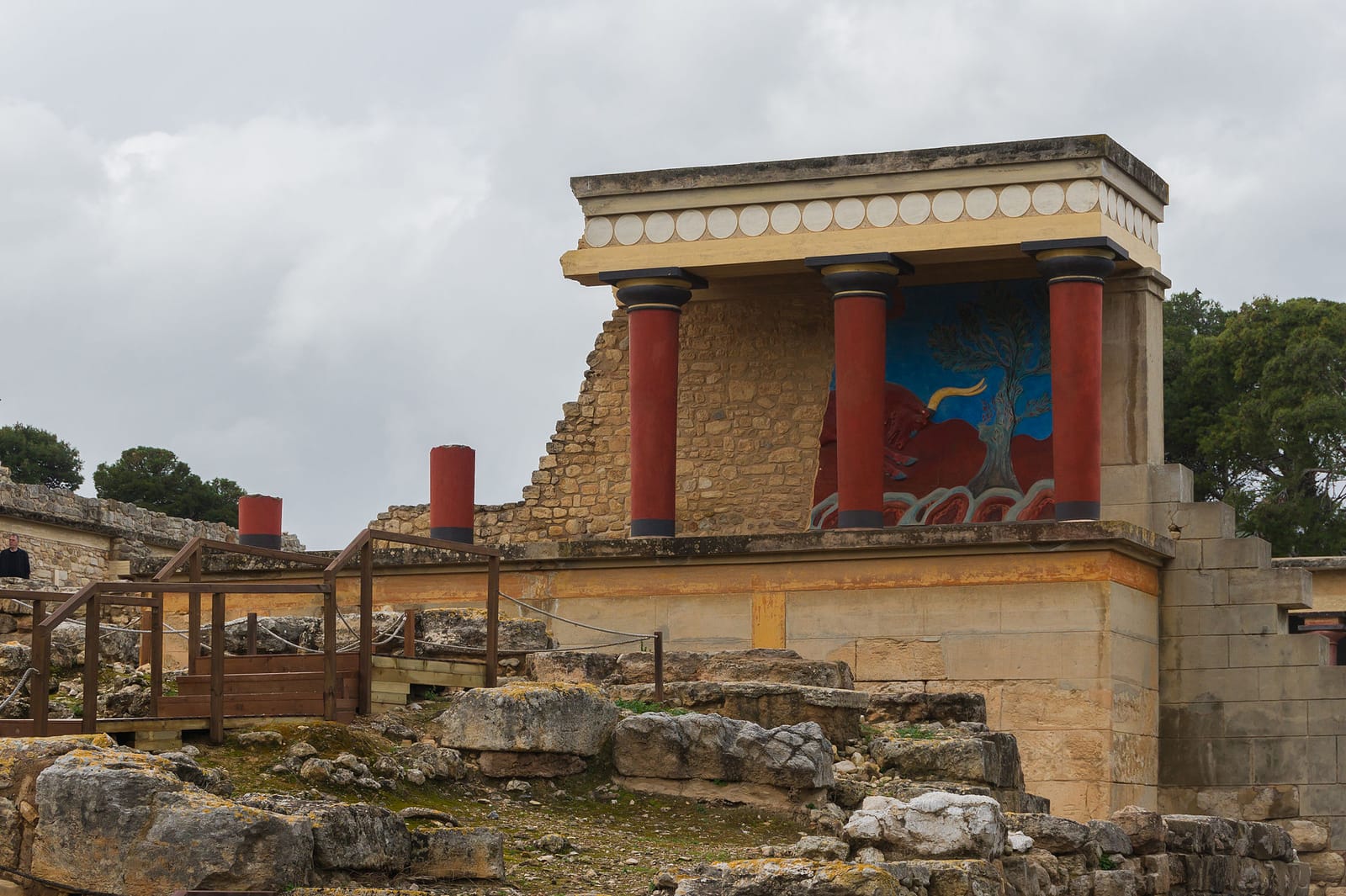
Homer knew Knossos as "a great city" where Minos was king, and later Greeks told of the labyrinth that Daedalus built there for the Minotaur. In 1900 the English archaeologist Arthur Evans began digging the low hill where Knossos had stood and uncovered a Bronze Age palace so large and so intricate that it seemed to explain the legend. He named a whole civilisation after Minos. Then he rebuilt parts of the palace in reinforced concrete, so that visitors today walk through Evans' idea of Knossos as much as through Knossos itself.
Minos' city
In the Odyssey, Odysseus, in disguise, spins Penelope a tale of Crete, an island of ninety cities and many languages, and names its greatest:
τῇσι δʼ ἐνὶ Κνωσός, μεγάλη πόλις, ἔνθα τε Μίνως ἐννέωρος βασίλευε Διὸς μεγάλου ὀαριστής,“Among their cities is the great city Cnosus, where Minos reigned when nine years old, he that held converse with great Zeus,”
Debated among scholars What the rare word enneōros means here is uncertain. The translation above takes it as "nine years old"; others understand "for nine years", or "in periods of nine years", and Plato already read Homer as saying that Minos went every ninth year to consult his father Zeus.
In the Iliad, the god Hephaestus decorates Achilles' shield with a dancing floor like the one Daedalus made for Ariadne in wide Knossos. By the fifth century BC Minos had become a figure of history as well as of myth. Thucydides makes him the first ruler of the sea:
Μίνως γὰρ παλαίτατος ὧν ἀκοῇ ἴσμεν ναυτικὸν ἐκτήσατο καὶ τῆς νῦν Ἑλληνικῆς θαλάσσης ἐπὶ πλεῖστον ἐκράτησε“Minos is the earliest of all those known to us by tradition who acquired a navy. He made himself master of a very great part of what is now called the Hellenic Sea,”
Ancient tradition / legend No evidence outside Greek tradition names a king Minos. Whether "Minos" was one man, a title, or a memory of Crete's real Bronze Age power cannot be settled.
The labyrinth
The later mythographers told the rest: the bull from the sea, Queen Pasiphae's passion for it, the Minotaur born of their union, and the prison built to hold him.
Μίνως δὲ ἐν τῷ λαβυρίνθῳ κατά τινας χρησμοὺς κατακλείσας αὐτὸν ἐφύλαττεν. ἦν δὲ ὁ λαβύρινθος, ὃν Δαίδαλος κατεσκεύασεν, οἴκημα καμπαῖς πολυπλόκοις πλανῶν τὴν ἔξοδον.“and Minos, in compliance with certain oracles, shut him up and guarded him in the Labyrinth. Now the Labyrinth which Daedalus constructed was a chamber “that with its tangled windings perplexed the outward way.””
Debated among scholars Evans believed the legend remembered the palace itself, with its maze of rooms and corridors, and he connected the word labyrinthos with labrys, a word that Plutarch says the Lydians used for an axe: the double axe is one of the commonest religious signs at Knossos. The idea is attractive and has never been proved.
Before Evans
Well established Evans was not the first to dig at Knossos. In 1878 a Cretan merchant and antiquarian, Minos Kalokairinos, cut trial trenches into the hill and found the palace's western storerooms, still lined with enormous storage jars (pithoi), but his work was soon stopped. Crete was then under Ottoman rule. Once the island had won its autonomy, Evans was able to buy the site, and by early 1900 he held both the land and a permit to dig.
The palace of Minos
Well established Work began on 23 March 1900. Evans' workmen uncovered a vast complex of courtyards, halls, staircases and storerooms, and clay tablets written in scripts that no one could read; Evans distinguished two of them, which he called Linear A and Linear B. He coined the word "Minoan" for the civilisation of Bronze Age Crete, and spent much of the rest of his life on it, publishing his results in the many volumes of The Palace of Minos at Knossos.
Well established The site is far older than Evans' palace. People lived on the hill in the Neolithic, thousands of years earlier, and the palace itself was built and rebuilt through the second millennium BC.
Rebuilt in concrete
Well established Much of Knossos had been built of rubble, mud brick and timber, and its wooden columns and upper floors had long since burned or rotted away. To protect what he found and to show what he believed had stood there, Evans had parts of the palace rebuilt. The Grand Staircase had been restored by 1905. Later he turned to what he called "reconstitutions" in the most modern material of his day, reinforced concrete, with columns painted red and black. The wall paintings, found in fragments, were completed by the Swiss artist Émile Gilliéron and his son, sometimes from small fragments, and it is often their versions that are reproduced on the site and in books.
Debated among scholars The reconstructions saved parts of the site that would otherwise have crumbled, and they let visitors imagine a building that is otherwise hard to read. But they fix one man's interpretation in concrete. Even in Evans' lifetime scholars began to doubt some of his reconstructions and interpretations, and historians such as Cathy Gere and J. A. MacGillivray have shown how much his peaceful, goddess-worshipping Minoans owed to the hopes of his own age.
What Evans could not accept
Well established Evans was wrong about one great question. He believed that Minoan Crete had dominated the Greek mainland to the end, and he never accepted that the relationship had changed. In 1952, eleven years after his death, Michael Ventris showed that the Linear B tablets from Knossos were written in Greek: in the palace's last phase, its administrators wrote in the language of the mainland.
- NeolithicThe first settlement on the hill of Knossos.
- 2nd millennium BCThe palace is built, destroyed and rebuilt.
- 14th c. BC (disputed)The Linear B archive, written in Greek. Debated among scholars
- 5th c. BCThucydides makes Minos the first master of the sea.
- 1878Minos Kalokairinos digs trial trenches and finds the storerooms.
- 23 March 1900Arthur Evans begins his excavations.
- by 1905The Grand Staircase is restored.
- 1952Michael Ventris shows that Linear B is Greek.
Read it yourself
Sources
Ancient sources, in the library
Modern scholarship
- Cathy Gere, Knossos and the Prophets of Modernism (Chicago: University of Chicago Press, 2009). Evans' Knossos and what the twentieth century made of it.
- J. A. MacGillivray, Minotaur: Sir Arthur Evans and the Archaeology of the Minoan Myth (London: Jonathan Cape; New York: Hill and Wang, 2000). A critical life of Evans.
- Antonis Kotsonas, Greek and Roman Knossos: The Pioneering Investigations of Minos Kalokairinos (Annual of the British School at Athens 111, 299–324, 2016). Minos Kalokairinos, the first excavator.
- Oliver Dickinson, The Aegean Bronze Age (Cambridge: Cambridge University Press, 1994). Minoan Crete in its Bronze Age setting.
Every Greek quotation here is checked word for word against the edition it cites, and every translation against the translation named. Written 28 September 2026.